Thursday, April 30, 2020

THE MANY DEBTS WE OWE TO LENIN


subhash gatade


'The workers’ and peasants’ government… calls upon all the belligerent peoples and their government to start immediate negotiations for a just, democratic peace.
By a just or democratic peace, for which the overwhelming majority of the working class and other working people of all the belligerent countries, exhausted, tormented and racked by the war are craving [we mean] an immediate peace without annexations – that is, without the seizure of foreign lands, without the forcible incorporation of foreign nations and without indemnities.'

The ‘just and democratic peace’ sought by the workers and peasants government never arrived.

It was on 26 th October 1917 when Lenin, the 47 year old leader of this nascent Government, read out the Bolshevik Decree on Peace. This appeal fell on deaf ears.
The many players and participants in the first World War,  the imperial powers fighting for a re-division of the world, which had already claimed millions of lives, refused to put a halt to their killing machines and the war continued for more than a year, adding menacing figures to the tally of the dead as well as the wounded. Students of history tell us that this ‘War to End Wars’ as it was termed then culminated in the deaths of more than nine million combatants and seven million civilians as a direct result of the War and the resulting genocides and related 1918 influenza pandemic causing another 20-50 million deaths worldwide.
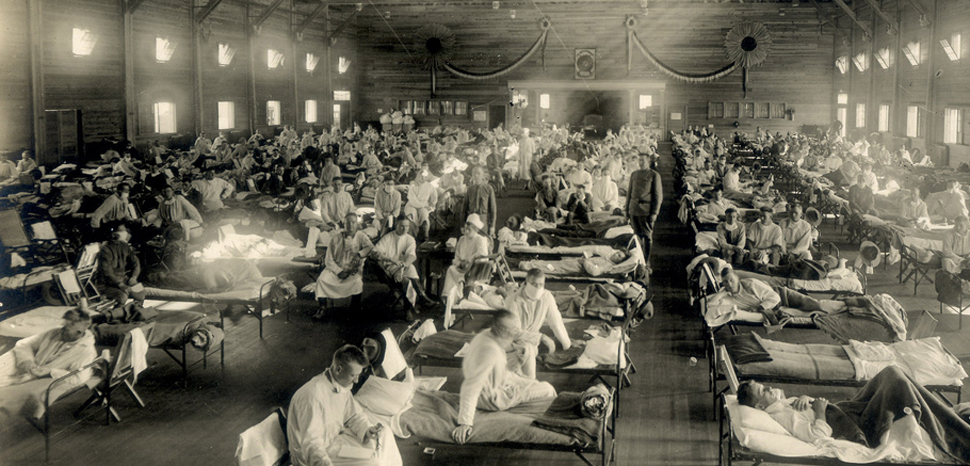
Otis Historical Archives, modified, https://commons.wikimedia.org/wiki/File:Emergency_hospital_during_Influenza_epidemic,_Camp_Funston,_Kansas_-_NCP_1603.jpg, CC 2.0, modified
Looking back one knows that if this decree on peace had been positively responded, few more million deaths in the ongoing war could have been avoided and deaths due to the pandemic of Spanish Flu ( 1918) could have been contained more effectively. Experts can tell you how the trenches of the western front proved ideal for spread of the virus as “[t]renches were flooded much of the time. Blood and bodily remains from people and animals that had been blown to pieces, along with faeces and rotting food, formed the pathways and shelters for troops going to and returning from, the front.”
The World War I which eclipsed all previous wars by its scale of destruction finally came to an end in 1918.
It is a different matter that for the newly emergent Soviet government – which had unilaterally decided to quit this war after the revolution ( October 1917) – had no respite from a civil war waged by Czarist era Generals, who favoured political monarchism, capitalism, and received support from eight foreign nations comprising of former Allied military forces from the World War and the pro-German armies. It continued till 1923 when the White Army received a resounding defeat at the hands of the Red Army.
The Bolshevik October Revolution - Photo Essays - TIME
History bears witness to the fact that it was largely because of Lenin’s inspired leadership that the Soviet government managed to survive against such military odds.
As the world celebrates Vladimir Ilyich Ulyanov (22 April 1870[b] – 21 January 1924), better known by his alias Lenin, who led the historic October revolution,  on his 150 th birth anniversary,  there is an increasing acknowledgement that ‘[n]ot only in the scholarly circles of the former Soviet Union but even among many non-Communist scholars, he has been regarded as both the greatest revolutionary leader and revolutionary statesman in history, as well as the greatest revolutionary thinker since Marx.’
What made Lenin ‘century’s most significant political leader‘ who died at a relatively young age ( according to today’s standards) of 54 years with roughly last around one and half years of his life remaining largely bed ridden because of the strokes he faced first in May 1922 and the second one in December 1922.  And why all those busting of Lenin’s statues in the ex-Soviet world or in places where rabid right-wing formations are on ascendant has not dampened thinking people’s increasing enthusiasm for this man and his ideas who even Maxim Gorky, a great Russian writer and political activist himself, who was a personal friend of Lenin, found to be unimpressive in his first meeting :
I felt there was something missing in him. …He was too plain, there was nothing of ‘the leader’ in him.
Vintage 1908 Chess: Vladimir Ilyich Lenin vs Maxim Gorky - YouTube
Perhaps a best measure of the greatness of a wo/man can be had if one can imagine a world invisibilising her/his presence.
Imagine 19 th century biology absenting Darwin from it or 20 th century physics by subtracting Einstein from it. Similarly, think of 20 th Century without Lenin !
Yes, it is just a mind game and things do not happen that way but absent Lenin from 20 th Century, and you will be at wit’s end to see a significant part of 20 th Century history – dotted with revolutions from Russia to China or the national liberation struggles in colonial countries, which received unstinting support in the first Congress of the Third International, at the behest of Lenin – just getting obliterated or slipping from the annals of history.
In fact, the more one looks at the life and times of Lenin, and the ‘[d]ecades of excruciatingly demanding organisational and theoretical work – much of the time in exile or in hiding or as a fugitive from the Czar’s gendarmes’ (-do-) which he executed with tremendous political will, one observes how Lenin’s ideas have sipped deep into our consciousness, without even a faint realisation that it was he who put forward those bold ideas first, which broke new grounds in revolutionary strategy and tactics.
Plekhanov
One can look at his efforts along with the then doyen of Russian Marxism, Georgi Plekhanov and Martov etc to bring out a newspaper ‘Iskra’ ( The Spark) which was aimed at unifying Marxist groups spread over Russia, when under Czarist autocracy and the tremendous repression unleashed by it, the average life of any such group was limited to few months / weeks or his first major theoretical work ‘The Development of Capitalism in Russia‘ ( 1899) in which he questioned the prevalent populist understanding that the peasantry was a homogeneous social class and showed the growing penetration of capitalism in the peasantry and how the peasantry was getting further differentiated. This monograph, in fact, even transcended what his one time mentor Plekhanov had argued in his positions vis a vis Russian peasantry and opened up the possibility of a section of Russian intelligentsia’s joining the Social Democrats, who earlier felt that Marxism was inapplicable to peasant Russia.
Or look at the concept of vanguard party, which emerged in the ensuing ideological political struggles within the Russian Social Democrats – as they were called then. What were the points of debate within the Social Democrats then ?  The debate veered around emergence of Socialist Consciousness among the workers. Lenin explained that under capitalism a worker can at best have trade union consciousness and class consciousness has to be brought from ”outside”. For it to happen a “party of a new type” is needed which would be “vanguard of the proletariat’.
Today it is difficult to even imagine any really progressive transformation of society and state without the a existence of a vanguard party but one feels surprised to know that in the early years of 20 th Century, a section of the Social Democrats did believe in ‘spontaneity of the masses’, for whom ‘movement was everything ‘
Definitely all these debates which Lenin led or all those struggles he unleashed came at a great personal cost.
His fiery debate with his one time mentor Plekhanov or his ultimate partying of ways with his close friend and Comrade Martov, is rather difficult to believe.
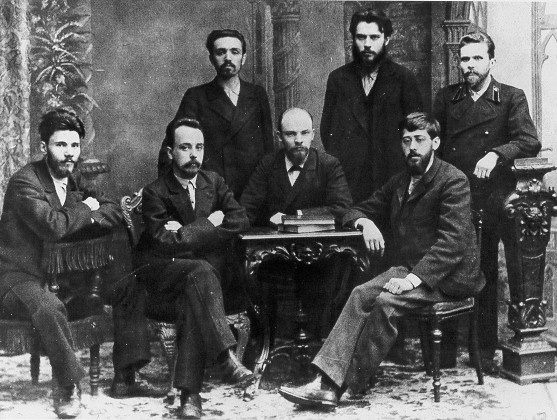
The Mensheviks
Martov, Lenin’s contemporary, a great Marxist scholar himself, with whom Lenin had established St. Petersburg Union of Struggle for the Liberation of the Working Class ( 1895), and was very close to Lenin, disagreed with Lenin’s understanding of the party, in the second Congress of the Russian Social Democratic Party, and later became leader of the Menshivk faction of the Party. Lenin always regretted his departure. His warmth towards him remained till the end. We are told that when Lenin discovered that Martov was ill ( 1922) in Germany he even asked his associates to transfer money to him.
Anyone who has had a close look at his collected works – which have been compiled in more than 45 volumes- would be rather amazed that he was equally at ease in discussing philosophy. In fact, when a section of  social democrats, which included the well known Anatoly Lunacharsky, who later became People’s Commissar responsible for Ministry and Education, undertook a ‘campaign against the philosophy of Marxism‘  Lenin took up the onerous task of responding to them in the form of a monograph of few hundred pages titled ‘Materialism and Empirio-criticism : Critical Comments on a Reactionary Philosophy.’
File:Lenin and Lunacharsky inspect the guard of honor, 1920.jpg ...
Photo : Lenin and Lunacharsky inspect the Guard of Honour, 1920
He was one of those rare revolutionaries – who had a theoretical acumen transgressing leading lights of the period but simultaneously a deep sense of practical politics and tremendous faith in the initiative of the masses.
Today, it would appear unbelievable to even young people inclined towards progressive politics that when the first world war started, ( August 1914)  when Socialist Parties throughout Europe decided to side with ‘their’ bourgeoisie, relegating the resolution of the Second International to the dustbin, which had decided to resist or overthrow their respective governments, if such an imperialist war breaks out, Lenin mobilised revolutionary socialists forces to “transform the imperialist war into civil war.” He made it absolutely clear that “The real enemy of the worker was not the worker in the opposite trench but the capitalist at home ”  and it was incumbent on the workers as well as the soldiers to target their own rulers and lead the destruction of the very system that had plunged them into such carnage.
Lenin’s fifty plus years political life which remained stormy till the end is dotted with many such episodes.
One can just go on and on to further throw light on the way he analysed Imperialism in a monograph and explained it how it is ‘the highest stage of capitalism’ or how he discussed State under socialist society or how he asked the proletariat to lay claim over power, when the opportune moment came, when he rightly sensed that the Provisional Government which had come into place after Czar was overthrown had lost popular support and how ‘All Power to the Soviets‘ became a rallying cry of the Workers, peasants and soldiers.
His ability not to stick to dogma – as opposed to many of his contemporaries – made a significant difference in his ability to ride over a dynamic unfolding situation.
As reports tell us there have been celebrations across the world led by the Working masses and communist and workers parties, formations, to remember Lenin on his 150 th birth anniversary in these times of quarantine.
A period marked by the Corona pandemic which has already claimed more than 1.5 lakh lives across the world. A period when the dire experiences of the policies of Profits over People seem to be coming to the fore.
On this occasion it is worthwhile to remember that in 1918 – under the leadership of Lenin himself – the Soviet Union became the first country to promise universal “cradle-to-grave” healthcare coverage, to be accomplished through the complete socialization of medicine. The “right to health” became a “constitutional right” of Soviet citizens.
Lenin is gone long ago but his dreams, his ideas, his proclamations are nesting everywhere. Was not it Brecht, who had written somewhere :
–Lenin  is enshrined
In the large heart of the Working People
He is our teacher
He carried the struggle along-with us
He is enshrined
In the large heart of the Working People


Sunday, April 26, 2020

THE MAN WHO KNEW INFINITY

Remembering Great Mathematician SrinivasaRamanujan on his hundredth death anniversary


Srinivasa Ramanujan Facts: 40 Facts on Self-Taught Mathematical Genius
Photo Courtesy : https://factslegend.org/

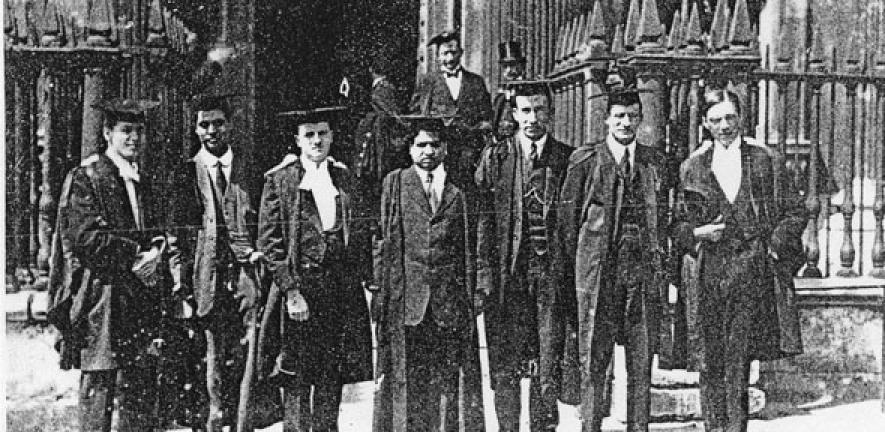
It was the year 1913 when Srinivasa Ramanujan, then an ordinary clerk in Madras Port Trust, drafted letters to Prof G H Hardy, then a leading mathematician at Cambridge University, containing his mathematical theorems.
The rest as we know is history.
Prof Hardy, immediately recognised these notes have come from “a mathematician of the highest quality, a man of altogether exceptional originality and power” and convinced him to come to Cambridge for further studies. After lot of persuasion Ramanujan went there and worked with Prof Hardy and other leading mathematicians there for around five years.
Opinion: The man who taught infinity: how GH Hardy tamed Srinivasa ...
He was elected a Fellow of the Royal Society, the second Indian admitted after Ardaseer Cursetjee in 1841, for his research and became the first Indian to be elected a Fellow of Trinity College, Cambridge. What is rather tragic that he was plagued by health problems throughout his life and he died when he was hardly 32 years old. ( 26 th April 1920)
Compared to all time greats, Ramanjunan made path-breaking contributions to mathematical analysis, number theory, infinite series, and continued fractions, in his short life, and his biographers tell us how his ‘notebooks—containing summaries of his published and unpublished results—have been analyzed and studied for decades since his death as a source of new mathematical ideas’. (https://www.youtube.com/watch?v=fGFK7rhpbWk)
The limitations of his knowledge were as startling as its profundity. Here was a man who could work out modular equations, and theorems of complex multiplication, to orders unheard of, whose mastery of continued fractions was, on the formal side at any rate, beyond that of any mathematician in the world … It was impossible to ask such a man to submit to systematic instruction, to try to learn mathematics from the beginning once more.
On the other hand there were things of which it was impossible that he would remain in ignorance … so I had to try to teach him, and in a measure I succeeded, though I obviously learnt from him much more than he learnt from me.

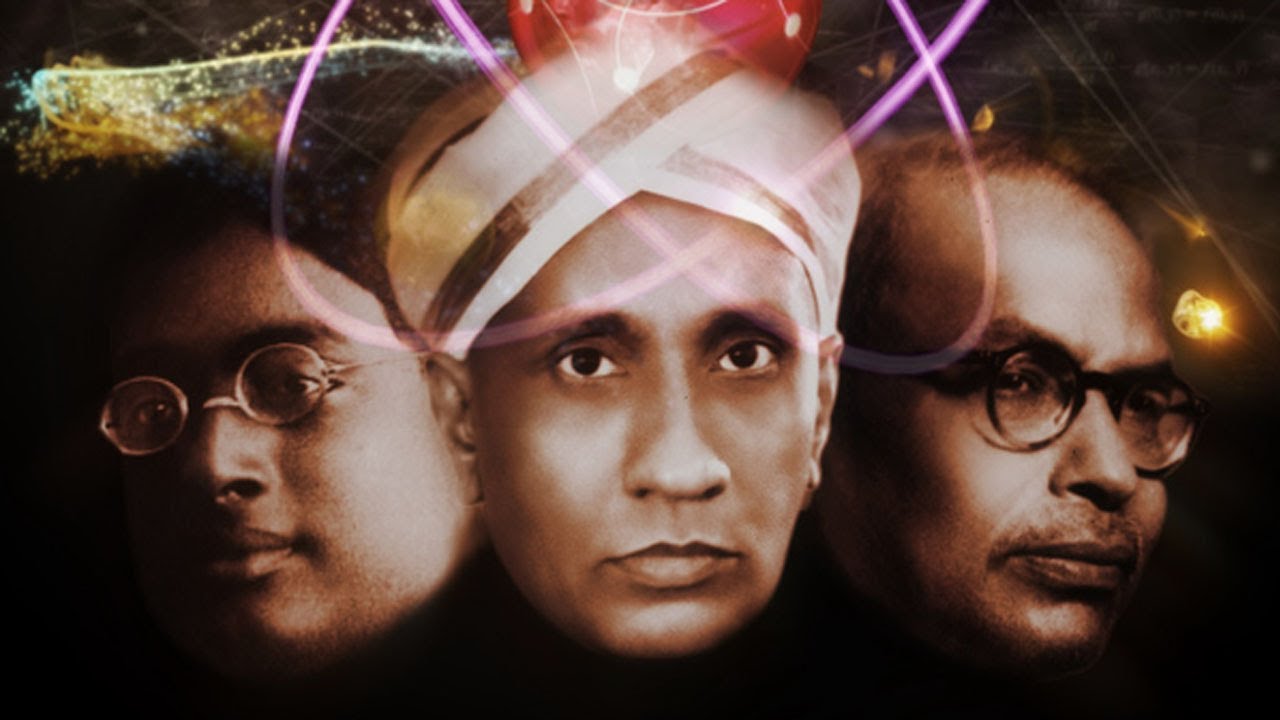
As we remember one of the Greatest Mathematician India has ever seen on his hundredth death anniversary, we cannot forget the fact that it was the same period, when India was still a colony and a very backward country, when famines and pandemics use to see deaths of millions of Indians, India also witnessed the flowering of its geniuses in the field of Physics who revolutionised this branch of knowledge with their own theories. We remember them as C V Raman ( 1888-1970) who was later awarded Nobel Prize, the first Indian to receive it who redefined how we see light and colour, Meghnad Saha ( 1893- 1956), Satyen Bose ( 1894- 1974).
The Quantum Indians Trailer - YouTube
( Photo Courtesy : ‘The Quantum Indians, a documentary by ‘Public Service Broadcasting Trust)

No doubt the list is incomplete, there were many others, who blazed other fields of knowledge. Can we ever forget the contributions of Jagdish Chandra Bose ( 1858-1937) and Prafulla Chandra Ray ( 1861-1944) and many others.
For us it is a puzzle, how could a backward, colonial India, created such geniuses – who are still remembered for their contributions – and why today despite being the third largest Scientific and Technological human power, we seem to be lagging behind.
Perhaps it is high time that we search for answers.
-Umang Library
…..because books are pathway to a new world

Wednesday, April 8, 2020

कोरोना, पूंजीवाद और सभ्यता: इस दौर के बाद पूछे जाने वाले कुछ सवाल


रवि सिन्हा 

आखिर किस पर दोष मढ़ा जाय? कुछ वक्त तक तो निशाने पर चीन रहा, जब तक कि हिंदुस्तानियों का सबसे पसंदीदा शिकार परदे पर नमूदार नहीं हो गया- आप जानते हैं वो कौन है। यह वायरस यदि कहीं मध्य-पूर्व या पाकिस्तान से आया होता तो दोष मढ़ने के इस कारोबार में ज्यादातर भारतीयों को मौज आ जाती!

इंसानी इतिहास नए-नए विषाणुओं का गवाह रहा है। हर नया वायरस दूसरों से ज्यादा जानलेवा रहा है। इतना तो तय है कि यह संकट जल्द ही बीत जाएगा और मनुष्यता महफूज़ रहेगी। सवाल है कि इस दौर के बीत जाने के बाद हम नुकसानों की गणना कैसे करेंगे? वो सब कुछ, जो हमने गंवा दिया?
सरकारों और नेताओं का मूल्यांकन इस आधार पर होगा कि उन्होंने संकट की घड़ी में क्या किया और क्या नहीं। बेशक, इस कसौटी पर उनका फैसला होना ही चाहिए, लेकिन हमें उम्मीद है कि मानवता खुद अपने जीवन और मरण के बारे में भी कुछ न कुछ सोचेगी। जिंदगी सिर्फ उन्हीं की नहीं जाएगी जिन्हें वायरस मारेगा। इससे कहीं बड़ी संख्या इसके आर्थिक, सामाजिक और राजनीतिक परिणामों का शिकार होगी।

इस संकट के बाद हम में से कितने लोग उस आर्थिक और राजनीतिक तंत्र की ओर अपना ध्यान मोड़ेंगे जिसमें यह मनुष्यता जी रही है? अगर मनुष्यता का एक तिहाई भी किसी वजह से अपने अनावश्यक और अश्लील उपभोग को त्याग दे और सनक भरी भागदौड़ वाली जीवनशैली को छोड़ने पर बाध्य हो जाए, तो यह आर्थिक तंत्र ढह जाएगा। इसके बाद बची हुई दो तिहाई मनुष्यता के सामने बेरोजगारी का संकट पैदा हो जाएगा, जो भुखमरी तक जा सकता है।

उधर अपनी अंटी में खरबों की राशि दबाए शीर्ष अरबपति सरकारों और उनके माध्यम से जनता को बाध्य कर देंगे कि इस तंत्र को बचाने के नाम पर वे खरबों की और राशि उन्हे सौंप दें।
मनुष्यता के पास यदि इतनी रचनात्मकता, उत्पादकता, ज्ञान, कौशल और प्रौद्योगिकी है कि हम में से प्रत्येक व्यक्ति पर्याप्त भोजन और संतोष के साथ अमन चैन से परस्पर जी सके, तो इस किस्म की अपेक्षाओं को यूटोपियन कैसे मान लिया जाता है? आखिर क्यों हम कुकुरभोज वाली गलाकाट प्रतिस्पर्धा और भागदौड़ को जीवन जीने का सहज ढंग माने बैठे हैं?

आखिर क्यों दो तिहाई इंसानियत को जीने का मामूली सामान जुटाने के लिए अमानवीय श्रम करना पड़ता है? अपनी कुशलता और उत्पादकता के बावजूद शेष एक तिहाई मनुष्यता को लालची व मूर्ख बन जाने की ज़रूरत क्यों आन पड़ती है? और यह दुनिया इतने विवेकहीन तरीके से क्यों चलती जाती है जिसमें अरबपति लोग लगातार खरबों गटकते चले जाते हैं?

उम्मीद की जानी चाहिए हम में से कुछ लोग इस बात की भी पड़ताल करेंगे कि लोकतंत्र का हाल क्या हुआ है। आखिर कैसे लोकतंत्र जनता द्वारा अपने ही हितों के खिलाफ़ वोट देने की व्यवस्था में तब्दील हो गया? आखिर यह कैसे हुआ है कि समूची दुनिया में जनता पहले से कहीं ज्यादा मसखरे शासकों को अब चुन रही है? और ये महज जोकर नहीं हैं बल्कि दुष्ट भी हैं (जोक्वां फीनिक्स का किरदार याद करें)।

आखिर क्या वजह है कि राजनीति के तमाम संवेदनशील, मानवीय, सभ्य और तर्कपूर्ण तरीके अब बासी और उबाऊ माने जाने लगे हैं?

हमारे प्रिय अमर्त्य सेन ने अपनी जिंदगी का बड़ा हिस्सा इस बात को स्थापित करने में लगा दिया कि लोकतंत्र जीवनरक्षक होता है, कि लोकतांत्रिक समाजों में अकाल नहीं पड़ता। इस किस्म के लोकतंत्र और पूंजीवाद के सम्मिश्रण ने जिस तरीके से करोड़ों लोगों की अनावश्यक जान ली है, इन्हें गिनने के लिए अमर्त्य सेनों की फौज चाहिए होगी।

(इस बीच मुझे किसी ने बताया है कि दिल्ली में आकाश बहुत साफ़ दिख रहा है और जालंधर के लोगों को दशकों बाद एक सुबह हिमालय की चोटियों के दर्शन हुए हैं)

(रवि सिन्हा एमआइटी से फिजिक्स में पीएचडी धारी हैं और दशकों से वाम प्रगतिशील आंदोलन के साथ जुड़े रहे हैं )

साभार  -जनपथ

Monday, April 6, 2020

Corona, Capitalism and Civilisation


Ravi Sinha
“Who do you blame it on? For a while it was China, until the most favourite target for the Indians appeared on the scene – you know who. When it comes to the business of blaming, Indians (a large percentage of them) would have loved it if the virus had originated somewhere in the Middle East or in Pakistan.
But new viruses have always appeared in human history, some more deadly than others. This one is the newest such calamity. Sure enough, humanity will be found standing on the other side of this crisis. But, how shall we count the losses after this mayhem is over?
Governments and leaders will be evaluated for what they did or did not do during the crisis. Of course they should be judged for that. But one hopes that humanity would also give some thought to how it lives and dies. The loss of life would not be confined to those killed by the virus. A far greater number would be killed by the economic, social and political fall-outs.
In the aftermath of the crisis how many of us will turn our attention to the economic and political system under which humanity lives? This economic system collapses if one third of humanity for some reason suspends its voracious and profligate consumption and is forced to sit out of a lifestyle that is a mad rat race. Then two thirds of humanity is threatened with job losses and even starvation. And the top billionaires, while keeping the trillions they have already taken home, force the governments and hence the public to hand out to them further trillions so that the system can be saved.
If humanity has the kind of creativity, productivity, knowledge, skill and technology that each one of us can live relatively peacefully – with enough food and lot of fulfilment – why such expectations are considered utopian? And why this artificial and forced enacting of a dog-eat-dog competition and commotion is considered the normal mode of living? Why should two thirds of humanity do inhuman labour for pittance, why should one third of humanity be turned into guzzling idiots despite their smartness and productivity, and why should the world be run mindlessly thus, so that billionaires continue to grab trillions?
One hopes that some of us also begin to examine what has happened to democracy. How come democracy means that people vote against their own interests? Why is it that across the globe they have begun to elect, more often than not, jokers to rule over them? And these are not just jokers. They are invariably malignant jokers. (Remember the role played by Joachim Phoenix). Why is it that all sensible, humane, civilized and rational way of doing politics is considered stale and boring?
Our much beloved Amartya Sen has spent a glorious lifetime advertising that democracy saves lives – famines don’t happen in democratic societies. One would, however, need an army of Amartya Sens to count how many millions have been killed unnecessarily by the combination of capitalism and this kind of democracy.
(By the way, I am also told that Delhi sky is much clearer, and people in Jalandhar woke up to a view of Himalayan snow-peaks after decades.)”

·         The author has been associated with left and progressive movements for four decades. He was trained as a theoretical physicist and has a PhD degree from MIT


Saturday, March 21, 2020

Relief, Rehabilitation and Reconciliation in North East Delhi: Memorandum of Demands to the Delhi Government


Volunteers and concerned citizens involved in relief, documentation and rehabilitation efforts  submit a comprehensive memorandum of demands to the Delhi Government, highlighting the measures that the state must undertake in the aftermath of targeted violence. The memorandum details specific demands in areas of relief, compensation, legal assistance, medical and psycho-social trauma, impact of COVID-19, skilling, education, reconciliation and rehabilitation. They also call for investigation into the role of the Delhi police in the violence.

It has been endorsed by eminent citizens including activists, academics, writers, jurists.

Find the memorandum attached here and if you want to endorse it, click the following link


Saturday, November 30, 2019

Talking Faiz : 'In This Hour of Madness'


Academician, writer and social activist Zaheer Ali in Conversation with Subhash Gatade about his latest book ‘RomancingWith Revolution : Life and Works of Faiz Ahmed Faiz' (Aakar Books, Delhi, 2019) and why Faiz is ' extremely relevant in today's India'


This is the hour of madness, this too the hour of chain and noose You may hold the cage in your control, but you don’t command The bright season when a flower blooms in the garden. So, what if we didn’t see it? For others after us will see The garden’s brightness, will hear the nightingale sing
(This Hour of Chain and Noose (Faiz, Tauq o darkaMausam, 1951)

Like Ghalib, it is rather difficult for anyone to recollect when and how Faiz entered our lives.
When did one first read his 'MataeLauhoKalam..' or 'DarbareWatan Me Jab Ek Din..' or his depiction of beloved's 'SamundarAakhein'.. or heard about the travails and tribulations he faced in his life or the tremendous love and affection he was showered with wherever he went.

In fact, with passage of time one's fascination for Faiz seems to be increasing and it is a marker of his growing popularity that despite publication of quite a few books, monographs and articles on Faiz, one's thirst to know him does not seem satiated.

Prof Zaheer Ali's book 'Romancing the Revolution - Life and Works of Faiz Ahmed Faiz' is a welcome addition to this ever growing collection. We posed few queries before Prof Zaheer Ali and here follows his response :

SubhashGatade (SG) : Prof Zaheer Ali, Congratulations for this beautiful book on Faiz, which has very succinctly brought out various facets of Faiz's life. My first query is to you as a person. We have known you more as a social activist and an academician - basically a political scientist - who has many books to his credit as well and now a full book length study on Faiz but these are formal details, can you tell us more about yourself ?

Zaheer Ali ( ZA)  : The first query is about me personally. You got a bit surprised to see my book length study of Faiz because you are not aware of my works in Urdu. Prior to this study of Faiz I have written a book in Urdu dealing with “Allusions in the Poetry of Faiz”. I have other books mostly literary criticism in Urdu. I am known to Urduwallahs more as a literary critic than a social scientist and activist.

SG : In the preface of the book you emphasise how Faiz is 'extremely relevant in today's India'. It has been more than three decades that Faiz breathed his last (1984) and situation the world over has undergone tremendous changes. For a layperson it is rather difficult to fathom this idea of relevance. Can you please explain why do you think so ?

ZA : My comment about his relevance is in the sense that all those who believe in liberty, equality, justice and intend to transform the socio-economic and political conditions, in particular, in the Indian subcontinent may seek inspiration from his poetry. The reason is that, Faiz all his life was struggling against the dictators and the unjust social order. We in India are faced with fascism. In the Preface to my book I have also commented that organized fascism is much more dangerous and threatening to human values than dictatorship. So the progressives of myriad hues in India may seek inspiration from Faiz. In this sense he is relevant.

SG : For quite a few people, who have read, sung and admired Faiz all their lives and still draw inspiration from him, there are two episodes in his life which rather give a discomforting feeling. One is his reaction ( or say the lack of it) when British ruled India was partitioned into two countries and the second concerns separation of Bangladesh from Pakistan after a very bloody civil war.

The chapter 'Faiz : The Man' ( Page 83) you also mention 'Faiz lamented the lack of true independence in the 'independence... in his famous poem, 'YehDaagDaagUjala..'.he as such, did not take a stand against the division of the country'
We are also told that Faiz rather maintained a similar ambivalence when Pakistan army led by its Generals resisted the creation of Bangladesh. Is it true ?
How does one explain this ambivalence of a man who was a Marxist and as you write sticked to humanism all his life ?

ZA : There are two posers in your third query. First of all we must not lose sight of the fact that Faiz was neither a card holder of the Communist Party nor he was a freedom fighter in the sense the term is used in India. Immediately before the dawn of purported ‘independence’ he was in the British Indian army and you know why. You must also keep in mind that the CPI did not keenly opposed the partition of the country. Faiz never thought that what we got by way of independence was a sham and his famous poem on the subject is testimony to the fact.

On the issue of Bangladesh, his studied reticence naturally surprised many of his true admirers. After all he was a father of two daughters without a proper source of income, he was ageing and a marked man in Yahya Khan’s Pakistan.. This made him vulnerable though it does not justify his ambiguous standpoint on the massacre of the Bengalis by the Pakistani armed forces.

SG : Whenever one thinks of Faiz, one is reminded of Alys (1914- 2003) who started her life as a member of the British Communist Party at the age of 16 and who in the words of a commentator "..gave her today for a better tomorrow of the South Asian People", who was an accomplished journalist and activist as well and one gets a feeling that a proper evaluation of her role has to be done yet ? Any comment ?
I cannot stop myself from quoting one of her poems which she had written for Faiz :
I Will Sing of You Later, / When the tread of a thousand feet / the unending roll of sorrow / the breath of roses enfolding / the eulogies, the warranted praise / the drawn out memories of others / the grief of recalling, / the total acceptance of death are  over.
Then I will sing, / Not to the tread of thousand feet, / nor to the roll of sorrow / Nor will I lift the roses nor echo praise nor recall, nor accept / My song neither begins nor ends / It is eternity. (A Poem for Faiz written by Alys)

ZA :Alys was indeed a great lady, a committed Marxist, a devoted wife and a doting mother. I have quoted her at a couple of places in the book. A British Marxist lady whose husband was accused of sedition surviving with two daughter in a fanatically religious nation of Pakistan was itself a great achievement. I agree that her role with Faiz and as an individual should be properly assessed in a study. I am also looking forward to such a book.

SG : What are your future plans?

My future plan includes a book on Averroes (Ibn e Rushd), a 12th century Spanish Muslim scholar who is truly known as the father of secularism. The major difficulty for me is that some of the reliable sources about the life and works of Averroes are still available in Arabic only, a language that I don’t know. So, if this does not materialize, then I will write something on political Islam.

Author(s) :Zaheer Ali , Page No. : 335 | Year : 2020, ISBN : 9789350026298, INR : 1295)

Sunday, August 25, 2019

AAP, Article 370 and a Blind Alley


Subhash Gatade

Courtesy- BBC

"He came, he saw and he concurred"
- Caption of a RK Laxman cartoon in early 90 s

AAP's standon article 370 has confused and disheartened many.
For its workers the party has opened itself to attacks by its adversaries because of its support to stripping of statehood for Jammu and Kashmir and thus weakening its own plank for full statehood for Delhi which was its key slogan during the 2019 Lok Sabha campaign.
A section of its fellow-travellers who had high hopes of the experiment, activists/scholars - who were rather enthused with its 'participatory' approach - also feel betrayed or disheartened now.
It is a different matter that not many have made their displeasure known.
May be it is a sign of their increasing fatigue or possible cynicism with politics in general, they have preferred to share their frustrations at private levels only.
A long-time friend with whom one had taken baby steps in left politics and who later changed his track, became a camp follower of the 'Mai Bhi Anna' brigade, - called me in frustration:  'How can he do that ? Does not he understands that it is a challenge to constitutional governance and federal division of power in India’ and how it would further ‘stoke and strengthen majoritarian politics in the country’. It is a different matter his differences with AK ended then and there and he like many others did not go public with his frustration and anger.
Of late, one notices that the silence - among supporters/fellow travellers - which largely engulfed AAP's 'unprincipled' decision is slowly melting and dissenting ( or should one say 'perturbed') voices are being heard.
Close on the heels of a leader of the Narmada movement from Madhya Pradesh - who has been associated with AAP from its inception - who raised her objection to AAP's decision and who even claimed to raise the issue at higher levels in the party in future, now comes the news that one of its 'well-wisher, and someone who has been seriously supportive of the Aam Aadmi Party (AAP) through all the ups and downs in the years since its formation' has also decided to speak out as he feels 'perturbed by.. developments  and has written an 'open letter' to Kejriwal.
..extraordinary situation that has been created in this country with the unilateral, stealthy and therefore cowardly abrogation of article 370 and the locking down of the state of Kashmir, stationing anything between 50, 000 to 1 lakh troops in the state, arresting reportedly almost 4000 leaders and activists belonging to different political parties and completely shutting down the media. (-do-)

1.
The 'open letter' seems to be a bag of mixed emotions.
There is a sense of worry, concern, disquiet which is simultaneously tinged with few queries, suggestions and advice as well. It is tinged with little expression of grief over the state of affairs in the country.
There are places where the letter even sounds more like reminding the architect of this move - namely Arvind Kejriwal - his 'ideals' ('Gandhi is your lodestar, by your own account') and asking him to think what he ( Gandhi) would have done in similar situation if he would have discovered '..using the armed might of the state, abrogating all civil liberties, putting thousands of people behind bars? Would he have welcomed this move?' or at places even explaining his stand to a wider populace
..your nationalism is different from Gandhi’s and that you felt compelled to support the government, did you not feel the need, at the same time to at least say a few words at the unprecedented violence and immense cowardice of this murder of democracy? I am sure you know why I call this move cowardly. ..
There is a sense of bewilderment also that when even someone like Raj Thackreay 'could  see the game behind this so-called nationalist move' whereas Kejriwal badly failed and did not even feel the need to 'qualify his support to the government'  which is then followed by a query :
Is it because the Delhi elections are round the corner that you choose to keep silent even on this minimum? If that is so, that would be a very sad situation.
The writer has also underlined his appreciation of the move by opposition parties that they are coming together 'to demand the minimum – the release of all the leaders and activists arrested' in Kashmir and is also of the opinion that when larger issues of principles arise - fate of one government should not matter'.
At the end of the letter, the writer advices Kejriwal that he should develop his 'politics now' ( of course, not like a 'loony leftist' !) and explains what does politics means, how it is not 'fighting particular issues' but it is also about
..expanding the circle of friends and identifying the enemy; it is about being aware that the field you function in, is already populated by vested interests and even doing a simple thing like providing good and cheap education is a veritable battle. You rally your forces and isolate the enemy.
2.
Let me admit that coming from someone who has been a supporter of AAP and who has even helped him at some level in elections, this 'open letter' needs to be welcomed - not only because writer has voiced his concern openly - but also because taking a stand on this sensitive issue, where one even witnesses a mass frenzy of sorts, taking your neck out has its own disadvantages.
It does not mean I do not have my disagreements with how it analyses the predicament in which AAP finds itself today, where it is seen supporting a move which has even been described as 'constitutional coup' by academics/scholars. 
Looking at the tone of the letter it is clear that the writer feels that there would be some discussion on his observations which he has made public (may be for want of any proper forum to voice his opinion) or at least there would be some official/unofficial response to it.
As an outsider one can just wish him luck for this little expectation.
This pen pusher has his own doubts about any such response because earlier experiences in this case have not been encouraging. e.g. We have before us the experience of founder members of AAP  like Ms Madhu Madhuri - who happened to be a diplomat, when she was shouted down in a meeting just because she wanted to raise the 'act of vigilantism'  by 'supporters of AAP' targetting African women.
3.
Coming to the 'open letter' would it be correct to say that support for BJP's move on article 370 can be seen as a reflection of Kejriwal's understanding of nationalism as the writer feels constrained to say ?
While one needs to further unpack this understanding, one feels that this 'piecemeal approach' focussing on a particular decision - may / may not explain the reasons behind this about turn.
We need to (at least) relook/revisit some of the earlier ( or latest) controversial statements/ stands taken by Arvind Kejriwal.
If a differing view of 'nationalism' could be spotted as the reason for Kejriwal's support to abrogation of article 370, then  how does one explain his claims merely few months before elections when he made statements which were construed as 'polarising' ! One can recall when AAP's chances of an alliance with Congress, finally fizzled out Kejriwal claimed in a press conference - that according to 'our survey, no Hindu will vote for Congress anyway. Muslims were initially confused, but now they will vote for us,”. No details of the survey were ever provided, the claim was clearly construed as a statement which aimed at 'polarising' voters on religious basis. It was also seen as a growing realisation within AAP's ranks that ground is rapidly slipping from below their feet and election results vindicated it rather badly.
The abysmal performance of AAP was reflected in the fact that not only all its seven candidates lost the elections but five even lost their deposits. What had added salt to the wounds was that the party had lost even to the Congress. From a vote share of 54 per cent in 2015 and 67 out of 70 seats in the assembly,  to just 18 per cent in 2019.
Atishi Marlena - the party's key face in the elections to the parliament - for who deputy Chief Minister had campaigned rather aggressively, was a distant third, losing even to Congress's Arvind Singh Lovely.  Remember how Atishi - daughter of Marxist parents who had named her in a different manner - was rediscovered as a 'Punjabi Hindu' during elections, supposedly to blunt the opposition propaganda that she was a 'Christian' but that also did not help her in any way.
Was not it a sign of desperation in the ranks of AAP that they had to go for a 'makeover' of Atishi Marlena and project her as 'Punjabi Hindu' and it had no qualms that all these steps were hitting at its claim to be a flag-bearer of 'alternative politics'.
Analysts have also noted 'perceptible attempt at reinforcing Kejriwal’s own identity as a‘Hindu’' post elections.
On June 4, 12 days after the Lok Sabha poll results, Kejriwal  retweeted a picture, “Swaminarayan Bhagwan Ka Abhishek’ (Kejriwal performing Abhishek of Swaminarayan ji) and went on to retweet four more pictures tweeted by the party’s official Twitter handle.
A day before, on July 4, Kejriwal had tweeted Eid greetings in a simple and unobtrusive manner, “Aap sabhi ko eid Mubarak”, there were no pictures.

One can also look at his announcement of free bus rides for women, which was done on Independence Day - which also happened to coincide with Raksha Bandhan and its implementation will begin on Bhai Dooj.
It also adds
Kejriwal had welcomed the court verdict in the Kathua gang-rape and murder of a minor, however, his silence on the lack of conviction of the six accused in the Pehlu Khan lynching case was too loud to go unnoticed. In the latter instance, Kejriwal did not even tweet. He delegated the same to his deputy Manish Sisodia. (-do-)
One can even look at Kejriwal's latest statement on the economic slowdown.
Die hardsupporters of the government have not minced words in lambasting the governmentfor its 'wrong economic and labour policies' and have demanded 'immediate course correction in the current economic and labour reform path the government has undertaken'  or central government's policy advisors have themselves admitted that India's economy is witnessing a slowdown, government's hand-picked Chief to the NITI Aayog seems ringing '[t]he alarm bell, calls for unprecedented steps' from the government, but Kejriwal seems to be hopeful.
In a publicmeeting he openly declared that he has '[F]aith in Centre to Deal With EconomicSlowdown; Delhi Govt Will Give Full Support'. He said that this  '[i]s one situation where the country has to stand as one and repair the economy' 
Perhaps somebody should ask him why should people further suffer - by supporting the government - when the government's pro-rich, pro-crony capitalist economic policies, which played further havoc with steps like demonetisation (DeMo) have landed us in this situation and despite enough warnings not only from opposition but its own advisers is still not ready to revise them nor express regrets for steps like DeMo.
4.
It is for everyone to see that with all that grandiose talks of 'alternative politics' what has emerged is a grand caricature of the very idea itself. The great warrior against corruption - which was presented to us by the media and buttressed by a section of the confused intelligentsia which had lost hope from the 'loony left' - appears like a pale shadow of himself.
Kejriwal's metamorphosis has even prompted even biting comments from some of those who were once enthusiastic about the whole experiment. A famous fact checker even captioned his post on Kejriwal - wherein he was seen singing paens to the government about its ability to deal with economic slowdown - as 'Chowkidar Kejriwal.'
One was suddenly reminded of a R K Laxman cartoon published in early nineties depicting the power struggle between Sharad Pawar and Narasimha Rao - who was then Prime Minister of India. It is part of history how Pawar had to finally submit to the authority of Rao.The cartoon  over these developments with few illustrations was captioned 'He came, he saw and he concurred'.
How the AAP experiment would further unfold remains to be seen but as the 'open letter' suggests many people who were once fascinated with the idea are suddenly finding themselves in a blind alley.