Relentless in exposing the sinister nature of the communal politics of the current ruling dispensation and meticulous in exposing the voodoo economic policies pursued by them which are disastrous to the Indian economy, Dr Parakala Prabhakar is going to speak on ‘The Political Economy of New India’ in this lecture.
About the speaker
Dr. Parakala Prabhakar, is an author, economist, and public intellectual. He served as Communications Advisor, held a cabinet rank position in Andhra Pradesh Government between July 2014 and June 2018. He was also a former spokesman and one of the founding general secretaries of Praja Rajyam Party.
For several years he presented a current affairs discussion programme on television channels of Andhra Pradesh. His programmes included Pratidhwani on ETV2 and Namaste Andhra Pradesh on NTV .
His book of essays ‘The Crooked Timber of New India : Essays on a Republic in Crisis‘ was widely discussed.
Dr Parakala completed his doctorate from the London School of Economics. He did his Master of Arts (M.A.) and Master of Philosophy (M.Phil.) from Jawaharlal Nehru University (JNU), New Delhi.
The talk looks at the practice of Gandhi in his struggle against communalism in the years leading up to Partition. This is a hugely controversial subject with polarised positions taken by his followers and critics.
The perspective of the talk emerges from Gandhi’s oft quoted but not heeded statement, My Life is My Message. The talk is a reading of a life text in this sense: Gandhi’s mission in Noakhali to mend the social fabric torn by communal riots and spread of communal ideology.
Gandhi’s search for a way out may offer some insights to those sharing his concern for a secular, plural society and polity today.
About the speaker
Professor at the Centre for Historical Studies, Jawaharlal Nehru University, till the end of February 2023, Professor Mahajan has been visiting professor and Fellow at different International and National Institutions.
She was member of the prestigious international research projects such as SPECTRESS and CHCI-MELLON Crises of Democracy, Global Humanities Institute. She has authored and edited many books on India’s Independence Struggle, Partition, Challenge of Communalism, Composite Culture etc
Publications :
Towards Freedom: Documents on the Movement for Independence in India,
1947, Parts One and Two, (edited and with an Introduction) OUP, 2013 and 2015.
Education for Social Change: MVF and Child Labour,
National Book Trust, New Delhi, 2008.
RSS, School Texts and the Murder of Mahatma Gandhi-
The Hindu Communal Project (with Aditya and Mridula Mukherjee) Sage
Publications, 2008.
Composite Culture in a Multi-Cultural Society
(Co-edited with Bipan Chandra), Pearson India & National Book Trust, New
Delhi, 2006.
Rites of Passage, A Civil Servant Remembers: H.M.
Patel, (ed.), Rupa & Co., New Delhi,2005.
Independence and Partition: The Erosion of Colonial
Power in India, Sage Publications, New Delhi, 2000.
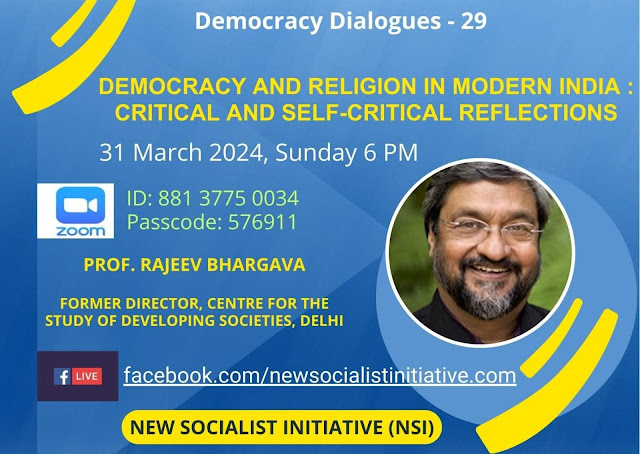
Professor Rajeev Bhargava delivered the 29th Democracy Dialogues Lecture on 31th March 2024
Abstract
"It is widely accepted that 'secular' is an alien category in India. This is too simplistic a view. But even if we agree with it, how come no one has asked if 'religion' is alien to India? My claim is that it is or at least it is as foreign to India as secular is. What are the implications of this thesis? What have been the consequences of religionization on Indian society and polity? How has it shaped Indian democracy? In my presentation, I shall expand these views and show why India needs secularism and in what form."
About the speaker
Renowned political theorist and former director of Centre for the Study of Developing Societies ( CSDS), Delhi Prof Rajeev Bhargava is currently an honorary fellow at the Centre and the director of its Parekh Institute of Indian Thought. He has taught at the University of Delhi and Jawaharlal Nehru University (Delhi) and has lectured, taught and held visiting professorships at several international universities.
Prof Bhargava’s work on individualism and secularism is internationally acclaimed. His publications include Individualism in Social Science (1992), What Is Political Theory and Why Do We Need It? (2010) and The Promise of India’s Secular Democracy (2010). His edited works include Secularism and Its Critics (1998), Politics and Ethics of the Indian Constitution (2008) and Politics, Ethics and the Self: Re-reading Hind Swaraj (2022), Bridging Two Worlds : Comparing Classical Political Thought and Statecraft in India and China (2023)
"It
is widely accepted that 'secular' is an alien category in India. This is too
simplistic a view. But even if we agree with it, how come no one has asked if
'religion' is alien to India? My claim is that it is or at least it is as
foreign to India as secular is. What are the implications of this thesis? What
have been the consequences of religionization on Indian society and polity? How
has it shaped Indian democracy? In my presentation, I shall expand these views
and show why India needs secularism and in what form."
About
the speaker
Renowned
political theorist and former director of Centre for the Study of Developing
Societies ( CSDS), Delhi Prof Rajeev Bhargava is currently an honorary fellow
at the Centre and the director of its Parekh Institute of Indian Thought. He
has taught at the University of Delhi and Jawaharlal Nehru University (Delhi)
and has lectured, taught and held visiting professorships at several
international universities.
Prof
Bhargava’s work on individualism and secularism is internationally acclaimed.
His publications include Individualism in Social Science (1992), What Is
Political Theory and Why Do We Need It? (2010) and The Promise of India’s
Secular Democracy (2010). His edited works include Secularism and Its Critics
(1998), Politics and Ethics of the Indian Constitution (2008) and Politics,
Ethics and the Self: Re-reading Hind Swaraj (2022), Bridging Two Worlds :
Comparing Classical Political Thought and Statecraft in India and China (2023)
Prof Romila Thapar delivered the 28th Democracy Dialogues
Lecture on 28 th January 2024
Abstract
My purpose in this talk would be to examine the link between history and
particular kinds of nationalism. I hope to show that nationalism can be a
process, bringing together and uniting all the communities that inhabit a
particular territory in support of a change in society or opposing a target
common to all. This earlier form is what I would like to call a unitary,
integrative nationalism that cut across communities and drew them together
in a particular country to support a single purpose. This I would differentiate
from the latter forms in some countries which identified with units of society
or communities according to certain common features, such as a particular
religion or language, or caste or ethnicity. I would call it segregated
nationalism, where each community is segregated and treated as having a
distinctly different identity and its own separate goal. History is brought in when
the community that gives an identity to its nationalism insists on tracing its
origins to a historical past. This pattern of integrated and segregated
nationalisms would seem to apply to India of the twentieth century. There was
the all-inclusive national movement whose participants were from every
community; its objectives were to maintain the unity of the Indian people and
overthrow colonial rule. The other nationalism, segregated nationalism, was
seeded in the 1920s and assumed the existence of two nations – the Hindu and
the Muslim – which, it was argued, go back to earlier times. Integrated
nationalism succeeded in 1947 in bringing about independence, but its
foundations needed strengthening, for we are now witnessing the strong presence
of religious nationalism in the attempt to inaugurate a Hindu Rashtra in India.
About the Speaker:
Internationally renowned scholar of Ancient History,
Prof Thapar was elected General President of the Indian History
Congress in 1983 and a Fellow of the British Academy in 1999. In 2008, she was
awarded the prestigious Kluge Prize of the US Library of Congress which
complements the Nobel, in honouring lifetime achievement in disciplines not
covered by the latter.
Prof Thapar has been a visiting professor at Cornell
University, the University of Pennysylvania, and the College de
France in Paris and holds honorary doctorates from the University of
Chicago, the Institut National des Langues et Civilisations Orientales in
Paris, the University of Oxford, the University of Edinburgh (2004),
the University of Calcutta and from the University of Hyderabad
Here is a select list of Prof Thapar’s publications
Ashoka and the Decline of the Mauryas, 1961 ( Oxford University
Press) ; A History of India : Volume 1, 1966 ( Penguin) ; The Past and
Prejudice, NBT ( 1975) ; Ancient Indian Social History : Some Interpretations,
1978 ( Orient Blackswan) ; From Lineages to State 1985 : Social Formations of
the Mid-First Millenium B.C. in the Ganges Valley, 1985 ( Oxford University
Press) ; Interpreting Early India, 1992 ( Oxford University Press) ;
Sakuntala : Text, Reading, Historie, 2002 ( Anthem) . Somanatha : The Many
Voices of History, Verso ( 2005) ; The Aryan : Recasting Constructs,
Three Essays ( 2008) ; The Past As Present: Forging Contemporary Identities Through
History, (2014) ;Voices of Dissent: An Essay, (2020); The Future in the
Past: Essay ( 2023)
Mani Shankar Aiya delivered the
27th Democracy Dialogues Lecture on 17th December 2023
Theme
On the face of it, we are an on-going democracy. We have a Constitution which has been honoured by the present government declaring 26 November as Constitution Day. We have regular elections at national, State and panchayat levels. We have the various institutions of democracy in place: an elected Parliament; an independent judiciary; an accountable executive; and a functioning, non-governmental media. Yet, there is fear all around. a new fear, a fear not seen since the Emergency, that has been spreading over the past decade. Why? Is it perhaps because the "spirit of constitutionalism", as Fali Nariman has put it in his latest work, missing? Can we continue to be the nation envisaged by Gurudev Rabindranath Tagore: "Where the mind is without fear/And the head is held high"? Are we progressing towards or in retreat from that "Heaven of Freedom" of which Tagore sang?. Are the institutions of democracy functioning? Is the Preamble being venerated or violated? Are our civil servants really free? Is our civil society being muzzled? Is the media glowing in the light of freedom of expression? Is the investigative and judicial process being made the punishment? Is the economy in any meaningful sense "socialist" as enjoined by the Preamble? Is the Constitution being reduced in practice to a non-justiciable set of Directive Principles of State Policy? Above all, are we as a nation still 'secular" - again as enjoined by the Preamble? Is Hindutva compatible with the basics and parameters of the Constitution? Is our 'unity in diversity" threatened or is it being revered?What are the challenges ahead that need to be addressed before we cease being the world's largest democracy?
The Speaker
Author of many books and a regular social commentator, Mani Shankar Aiyar, has had a distinguished foreign service career , he was Union Ministers during Congress led government (2004 till 2009) and has handled different ministries. Ministry of Petroleum and Natural Gas, ( 2004-06) Youth Affairs and Sports (2006-08), and Development of North Eastern Region ( 2008-09).
Here is a list of few of his publications :
Memoirs of a Maverick Juggernaut, 2023 ; A Time of Transition: Rajiv Gandhi to the 21st Century, Penguin, 2009 ; Confessions of a Secular Fundamentalist, Penguin, 2004; Rajiv Gandhi's India, 4 vols. (General Editor), UBSPD New Delhi, 1997,Knickerwallahs, Silly-Billies and Other Curious Creatures, UBS Publishers, 1995 . Pakistan Papers, UBSPD, New Delhi, 1994 ; One Year in Parliament, Konark, New Delhi, 1993 ; Remembering Rajiv, Rupa & Co., New Delhi, 1992 ; Rajiv Gandhi: The Great Computer Scientist of India, Mughal Publishers, New Delhi, 1991 ;How To Be A Sycophant, NBS, New Delhi, 1990
On
the face of it, we are an on-going democracy. We have a Constitution which has
been honoured by the present government declaring 26 November as Constitution
Day. We have regular elections at national, State and panchayat levels. We have
the various institutions of democracy in place: an elected Parliament; an
independent judiciary; an accountable executive; and a functioning,
non-governmental media. Yet, there is fear all around. a new fear, a fear not
seen since the Emergency, that has been spreading over the past decade. Why? Is
it perhaps because the "spirit of constitutionalism", as Fali Nariman
has put it in his latest work, missing? Can we continue to be the nation
envisaged by Gurudev Rabindranath Tagore: "Where the mind is without
fear/And the head is held high"? Are we progressing towards or in retreat
from that "Heaven of Freedom" of which Tagore sang?. Are the
institutions of democracy functioning? Is the Preamble being venerated or
violated? Are our civil servants really free? Is our civil society being
muzzled? Is the media glowing in the light of freedom of expression? Is the
investigative and judicial process being made the punishment? Is the economy in
any meaningful sense "socialist" as enjoined by the Preamble? Is the
Constitution being reduced in practice to a non-justiciable set of Directive
Principles of State Policy? Above all, are we as a nation still 'secular"
- again as enjoined by the Preamble? Is Hindutva compatible with the basics and
parameters of the Constitution? Is our 'unity in diversity" threatened or
is it being revered?What are the challenges ahead that need to be addressed
before we cease being the world's largest democracy?
Speaker
: Mani
Shankar Aiyar
Author
of many books and a regular social commentator, Mani Shankar Aiyar, has had a
distinguished foreign service career , he was Union Ministers during Congress
led government (2004 till 2009) and has handled different ministries. Ministry
of Petroleum and Natural Gas, ( 2004-06) Youth Affairs and Sports (2006-08), and
Development of North Eastern Region ( 2008-09).
Here
is a list of few of his publications :
Memoirs
of a Maverick Juggernaut, 2023 ; A Time of Transition: Rajiv Gandhi to the 21st
Century, Penguin, 2009 ; Confessions of a Secular Fundamentalist, Penguin,
2004; Rajiv Gandhi's India, 4 vols. (General Editor), UBSPD New Delhi,
1997,Knickerwallahs, Silly-Billies and
Other Curious Creatures, UBS Publishers, 1995 . Pakistan Papers, UBSPD, New
Delhi, 1994 ; One Year in Parliament, Konark, New Delhi, 1993 ; Remembering
Rajiv, Rupa & Co., New Delhi, 1992 ; Rajiv Gandhi: The Great Computer
Scientist of India, Mughal Publishers, New Delhi, 1991 ;How To Be A Sycophant, NBS, New Delhi, 1990
Professor Mridula
Mukherjee ( (Professor of Modern Indian History ( Retd), Centre for
Historical Studies, JNU) ), delivered the 26th Democracy Dialogues
Lecture on 19 November 2023
Summary :
In his lifetime, Jawaharlal Nehru was recognized the world over as a statesman and an Indian leader second only to Gandhiji. A foremost leader of the freedom struggle, who gave it a decided socialist orientation, he remained unrivalled as Prime Minister after independence and built the solid foundations of a sovereign, secular, democratic, and egalitarian republic. He evolved the concept of non-alignment which enabled many ex-colonial countries to avoid becoming a part of the two power blocs engaged in the Cold War.
However, he is today the favourite whipping boy of the establishment. We are told he was responsible for the partition, for the mess in Kashmir, for the death of Subhas Bose, for delaying the integration of Hyderabad, and of Goa, for the defeat at the hands of China in 1962, for neglecting agriculture, and primary education, and much else. The reason for the defamation is of course that he stood for the exact opposite of what is valued today. His life and work present a continuous question mark to the regressive trends in fashion.
This will become evident as we focus in the talk especially on two areas of great relevance today in which we are facing a grave crisis: Democracy and Civil liberties, and Communalism/Secularism. We will also focus attention on Nehru’s evolving understanding of Mahatma Gandhi’s vision and method of non-violent struggle, of which he became the most ardent advocate after his death.
Speaker :
Author of many books, Prof Mukherjee has been a visiting Scholar at Duke University, USA, and at the Institute of Oriental Culture, University of Tokyo and was also Director of Nehru Memorial Museum and Library, ( NMML), New Delhi.
She has published widely in the areas of agrarian history, peasant movements, social movements and the Indian national movement.
Here is a list of a few of her publications :
Colonializing Agriculture, The Myth of Punjab Exceptionalism Sage (2005) ; Peasants in India’s Non Violent Revolution : Practice and Theory (Sage 2004).
This list also includes India’s Struggle for Independence (1999) and India After Independence 1947–2000 (2000), RSS, School Texts and the Murder of Mahatma Gandhi The Hindu Communal Project (2008) co-authored with Prof Bipan Chandra and others.
In his lifetime, Jawaharlal Nehru was recognized the world over as a statesman and an Indian leader second only to Gandhiji. A foremost leader of the freedom struggle, who gave it a decided socialist orientation, he remained unrivalled as Prime Minister after independence and built the solid foundations of a sovereign, secular, democratic, and egalitarian republic. He evolved the concept of non-alignment which enabled many ex-colonial countries to avoid becoming a part of the two power blocs engaged in the Cold War.
However, he is today the favourite whipping boy of the establishment. We are told he was responsible for the partition, for the mess in Kashmir, for the death of Subhas Bose, for delaying the integration of Hyderabad, and of Goa, for the defeat at the hands of China in 1962, for neglecting agriculture, and primary education, and much else. The reason for the defamation is of course that he stood for the exact opposite of what is valued today. His life and work present a continuous question mark to the regressive trends in fashion.
This will become evident as we focus in the talk especially on two areas of great relevance today in which we are facing a grave crisis: Democracy and Civil liberties, and Communalism/Secularism. We will also focus attention on Nehru’s evolving understanding of Mahatma Gandhi’s vision and method of non-violent struggle, of which he became the most ardent advocate after his death.
Speaker :
Author of many books, Prof Mukherjee has been a visiting Scholar at Duke University, USA, and at the Institute of Oriental Culture, University of Tokyo and was also Director of Nehru Memorial Museum and Library, ( NMML), New Delhi.
She has published widely in the areas of agrarian history, peasant movements, social movements and the Indian national movement.
Here is a list of a few of her publications :
Colonializing Agriculture, The Myth of Punjab Exceptionalism Sage (2005) ; Peasants in India’s Non Violent Revolution : Practice and Theory (Sage 2004).
This list also includes India’s Struggle for Independence (1999) and India After Independence 1947–2000 (2000), RSS, School Texts and the Murder of Mahatma Gandhi The Hindu Communal Project (2008) co-authored with Prof Bipan Chandra and others.
Professor Ashutosh Varshney ( Sol Goldman Professor of International Studies and the Social Sciences at Brown University ), delivered the 25th Democracy Dialogues Lecture on 15 October, 2023.
Summary
India celebrated 75 years of its independence last year with a lot of enthusiasm.
Celebrations did not hide the fact it is also one of the leading countries which is passing through what is popularly known as 'democratic backsliding'.
A country which, like many others, is using democratic processes to secure undemocratic outcomes, where freely contested elections are being deployed for the purpose of expressing, cultivating, or enhancing majoritarian prejudices—to target minorities and turn them into lesser citizens.
In this scenario, there is an urgent need to unpack this journey of democratic India further , there is a need to make a distinction between India as an electoral democracy and India as a liberal democracy.
Background Reading for the talk :
# India’s Democratic Longevity and its Hugely Troubled Trajectory ( Attached with this mail)
#. How India's Ruling Party Erodes Democracy
Ashutosh Varshney
Journal of Democracy, Volume 33, Number 4, October 2022, pp. 104-118 (Article)
Prof Ashutosh Varshney is Sol Goldman Professor of International Studies and the Social Sciences and Professor of Political Science at Brown University, where he also directs the Center for Contemporary South Asia. Previously, he taught at Harvard (1989-98) and the University of Michigan, Ann Arbor (2001-2008).
His books include Battles Half Won: India’s Improbable Democracy (2013), Collective Violence in Indonesia (2009), Ethnic Conflict and Civic Life: Hindus and Muslims in India (Yale 2002), India in the Era of Economic Reforms (1999), and Democracy, Development and the Countryside: Urban-Rural Struggles in India (Cambridge 1995)
New Socialist Initiative is a collective committed to the belief that humanity can create a society free of economic deprivation, gender, caste, national and racial oppressions, and ecological degradation. It will be a society of associated humans which will ensure that 'the free development of each (will be) the condition for the free development of all'. This requires a social system run collectively for the welfare of all, as against capitalism that is run by the rich and the powerful for their private profit. While we uphold the legacy of socialist revolutions of the last century, we also believe that it is necessary to learn from their limitations and mistakes to successfully challenge new forms of political and ideological domination evolved by capitalism.