Saturday, June 27, 2015

विभाजन की लकीरें

- जावेद अनीस

सआदत हसन मंटो ने अपनी मशहूर रचना 'टोबा टेक सिंह' में एक मेंटल हॉस्पिटल का जिक्र करते हुए बताया गया कि सन47 में सिर्फ हिन्दुस्तान के लोग और ज़मीन नहीं बटें थे बल्कि मानसिक रोगियों का भी विभाजन हुआ था, दरअसल कहानी में ये मानसिक रोगी तथाकथित होशमंदों के प्रतीक थे.भारतीय उपमहाद्वीप के उस विभाजन को 66 साल हो रहे हैं जिसके नतीजे में भारत और पाकिस्तान नाम के दो राष्ट्र अस्तित्व में आए। यह 2015 है जब विभाजन के दौर की संतानें अपने उम्र के अंतिम पड़ाव पर हैं ,लेकिन ऐसा लग रहा है कि समय तीन सौ साठ डिग्री घूम कर फिर वहीँ पहुच गया है जहाँ हम उसे 1947 में छोड़ कर आगे बढ़ आये थे और 'टोबा टेक सिंह” के मेंटल भूतों की वापसी हो गयी है। विभाजन का सोया हुआ जिन्न जाग गया लगता है, हिन्दूओं और मुस्लिमों के नाम पर बनीं सियासी जमातों की राजनीति की मुख्यधारा में वापसी के संकेत बन रहे हैं और पंथनिरपेक्ष, बहुलतावादी और सहअस्तित्व के विचार हाशिये पर पंहुचा दिए गए लगते हैं।

वर्ष 2014 लोकसभा चुवाव ने मुस्लिम वोट बैंक, अल्पसंख्यक समुदाय के समर्थन के बिना भारत में कोई सरकार नहीं बना सकता है जैसे कई मिथ तोड़ दिए थे और देश में पहली बार एक बहुसंख्यकवादी मुकम्मल दक्षिणपंथी सरकार वजूद में आयी थी, जिसके मुखिया ने अपने चुनाव प्रचार के शुरुआत में मुम्बई की गलियों में पड़े पैमाने पर बड़े-बड़े होर्डिंग्स लगवाये थे जिसमें बड़े -बड़े अक्षरों में लिखा हुआ था ‘मैं हिंदू राष्ट्रवादी हूं’। अब जहाँ एक तरफ मुल्क के राजनीतिक पटल पर एक ऐसी राजनीतिक विचार सबसे बड़ी ताकत बन चुकी है जो बहुसंख्यकवाद की पैरोकार है और ऐसे दृष्टिकोण को बढ़ावा दे रही है जिससे राष्ट्र की एकता खतरे में पड़ सकती है, वहीँ दूसरी ओर एक ऐसी सियासी जामत भी पटल पर प्रवेश कर चुकी है जो चारमीनार के परछाईयों को दूर छोड़ते हुए पूरे देश के मुसलमानों के राजनीतिक गोलबंदी की दिशा में आगे बढ़ रही है। एक तरफ जहाँ आये दिन लव जिहाद, धर्मांतरण और हिन्दू राष्ट्र का शोर उठाया जा रहा है तो दूसरी तरफ यह ऐलान किया जा रहा है कि “इस्लाम सभी धर्मों का वास्तविक घर है और जब सभी धर्मों के लोग इसे अपनाएंगे,तब यह वास्तविक 'घर वापसी' होगी।“

इसी खेल को जारी रखते हुए केंद्र और महाराष्ट्र में बीजेपी सरकार के सहयोगी पार्टी के नेता और भारतीय संसद के सदस्य संजय राउत ने मुख्यपत्र “सामना” में मुसलमानों से वोट देने का अधिकार छीनने की मांग करते हुए लिखते हैं कि‘‘अगर मुसलमानों का इस्तेमाल केवल राजनीति करने के लिए इस तरह किया जा रहा है तो उनका कभी विकास नहीं हो सकता। जब तक मुस्लिमों का इस्तेमाल वोट बैंक की राजनीति के लिए होता रहेगा, उनका कोई भविष्य नहीं होगा और इसलिए बालासाहब ने एक बार कहा था कि मुस्लिमों का मताधिकार वापस लिया जाए। उन्होंने सही कहा था।’’ उन्होंने ऑल इंडिया मजलिस-ए-इत्तिहादुल-मुस्लिमीन (एमआईएम) और उसके नेताओं ओवैसी बंधुओं की तुलना भी ऐसे जहरीले सांपों से की जो अल्पसंख्यक समुदाय का शोषण करने के लिए जहर उगलते रहते हैं।अब बारी इस खेल के दूसरे खिलाडी एमआईएम के नेता असादुद्दीन ओवैसी की थी जिन्होंने “पलटवार’ करते हुए कहाकि “कोई माई का लाल मुसलमानों मताधिकार नहीं छीन सकता है”।

Thursday, June 25, 2015

Praful Bidwai Is No More

-Subhash Gatade

Praful Bidwai is no more. He died in Amsterdam on Tuesday evening due to a cardiac arrest.

With his death we have lost the 'best left-wing journalist' in this part of South Asia whose articles appeared in many newspapers and magazines in the subcontinent and in the middle east and was frequently published by The Guardian, Le Monde Diplomatique as well.

Praful will be missed by thousands and thousands of his readers (this pen pusher included) who were 'groomed' by him in a career spanning more than four decades. For them he was one such voice who remained uncompromising in his strident criticism of communal fundamentalisms of various kinds and the crony capitalism which is having a field day these days. He was a leading voice for nuclear disarmament and peace as well and had written extensively on it.

It was a strange coincidence that we met last in the capital when a memorial meeting was organised by Communist Party of India to remember the legendary Comrade Govind Pansare who was assassinated few days back. He was to speak in the meeting. The meeting was yet to start and I could steal some time to talk to him. He told he is working on a book - which was near completion - on the left movement in the country and had interviewed many activists associated with the movement to listen to their understanding of challenges before the left. And in that connection he had long meeting with Com Pansare - once in Kolhapur and one possibly in Mumbai. He shared his fascination about the energies he still had at that age for 'the cause'.

Few days after the meeting, there was a call from him asking for a phone number of a dalit activist which incidentally I did not have. Yes, that was the last time I spoke to him.

Monday, June 22, 2015

Hey Ram ! Madhav

- Subhash Gatade

Ram Madhav, the first official spokesperson of RSS (later removed or discharged from this role) and these days 'loaned' to BJP as a 'senior leader' engaged in what an analyst called double delete asana on International Yoga Day. The first of this kind of 'asana' - unheard before - was rather necessitated by the impetuosity with which the net savvy leader tweeted about 'absence of Vice President Hamid Ansari' from the celebrations and the 'blackout of the programme by Rajya Sabha TV which is chaired by him' and later tweeted 'an apology about the confusion' and within no time deleted both the tweets.

By evening it was clear that not only the Rajya Sabha TV had provided a live coverage of the programme but also provided clarifications about honourable Vice President's absence. It was revealed that he was not invited for the programme by the concerned minister. In fact his office had to issue a press release to the effect because of the insinuations which were being spread targeting him and perhaps also tell the likes of Ram Madhav that there is something called protocol which the Vice President has to follow.

One does not know whether it would be possible for Mr Ram Madhav to comprehend such nuances of democratic procedures because for him such details are of no consequence. In fact if he was really concerned about absence of Vice President of India in the said programme, he could have easily phoned his office and made further enquiry. But as we know he just wanted to underline his absence from such a programme of 'national glory' when India was supposedly 'leading the world'. It was an indirect way to further the illiberal and exclusivist agenda he has been exposed to since younger days. 

We know that this is not for the first time that the honourable Vice President has been targeted in such a lowly manner and a campaign of calumny and insinuation has been launched against him. During President Obama's visit also a similar controversy was raked up by the same elements when national anthem was being played during Republic Day celebrations at Rajpath. A photo of the programme was widely shared on social media wherein the President of India was seen to be saluting the national flag whereas Vice President Hamid Ansari and many other dignitaries were seen merely standing. 

"Why didn't Hamid Ansari salute the national flag?" This question seemed to be top most on the minds of the self-proclaimed defenders of patriotism then. In fact, home minister Rajnath Singh and external affairs minister SushmaSwaraj didn't salute the flag either, but as expected their patriotism was not questioned. Many hate tweets were hurled at the Vice President then ranging from "Jihadi sympathiser", "anti-India", "traitor", few of them even demanded that he be impeached also.

Friday, June 5, 2015

No To Ambedkar-Periyar in ‘Modern Day Agraharam’?

- Subhash Gatade
Whether discussing issues of contemporary concern among students, raising debates around them on the campus – taking inspiration from the ideas of leading social revolutionaries of 20th century – should be construed as an act of creating ‘social disharmony’ or ‘spreading hatred’ ?
Any sane person would rather reject this weird proposal but it appears that the bureaucrats in the Ministry of Human Resources Development (MHRD) think otherwise. It was evident in the way they acted on an anonymous complaint regarding the activities of a group of students in IIT Madras which calls itself ‘Ambedkar-Periyar Study Circle’ (APSC) – which comprises mainly of dalitbahujan andadivasi students. Perhaps they were worried that the particular students group, has been critical about PM Modi’s policies and has been raising issues of caste, communalism as well as corporate loot of resources and challenging the ‘development’ narrative which is popular these days among a section of people. The impetuosity with which they acted when they wrote to the management of the Institute can also be gauged from the fact that in this process they violated the recommendations of the CVC (Central Vigilance Commission) itself which has ‘barred’ organisations from taking action on such (anonymous) complaints.
As of now the issue of ‘derecognition’ of APSC by the IITM management, has snowballed into a major controversy, with issues of curtailment of freedom of expression, infringement of autonomy of educational institutions and dominance of caste in higher education all coming to the fore. There have been demonstrations in Madras/Chennai and other major cities protesting this arbitrary clamping down on a student’s group. There are reports that students from other institutions like Mumbai, Delhi and Kharagpur have come forward to form similar groups on their campuses to express their solidarity with them.
The way this issue has unfolded has also caused unease in the academic world in the west also and one learns that Prof Mumford, president of the International Mathematical Union and a former Harvard University professor, – who has been a regular visitor to the IITM campus – expressed his displeasure over the developments there in a mail. He has reminded the management that
 “..[c]ampuses must allow open discussion of divisive issues even when it offends some people so that all its aspects are out in the open. Today’s youth are tomorrow’s leaders and one wants them to think deeply about the direction to which we are headed.”
It is true that neither the ministry nor the management had expected that this move would be met with any resistance. Their assessment must have been that this ‘derecognition’ would give a signal to all dissenting voices on different campuses to either fall in line or face consequences. Taken aback by the strong reaction, they do not know how to wriggle themselves out of the situation.
According to reports the Smriti Irani led MHRD is at pains to explain that it did not try to dictate terms to the management of the IITM, and had nothing to do with this ‘clamping down’. It also wants to assure its detractors that it respects the autonomy of academic institutions. It is a different matter that there are no takers of this ‘line’ in the academic world. People are aware that the same ministry which felt concerned about activities of APSC has been a silent spectator about the activities of other right-wing Hindutva groups on the same campus, who have been spreading irrational ideas, superstitions and have no qualms in inviting controversial Gurus on the campus, freely using IIT’s name and resources. An idea of the activities such groups take up can be had from ‘Vivekananda Study circle’ (VSC) which was founded in late 90’s which has held talks which advocate Intelligent design and which claim the existence of Quantum Physics in Vedic Sciences. Forget action or censure, such organizations receive complete support of IIT administration.
Of course, it is not for the first time that actions by Ms Irani’s ministry have caused consternation on the campuses. Few months back, acting on representation from a RSS worker in Madhya Pradesh, it had taken the unusual step of policing university campuses to find out what was cooking in their kitchen. The directors of all IITs and IIMs were sent letters seeking details of cooking and catering arrangements in their institutions, and directing them to send “action taken’’ report on RSS swayamsevaks’ demand for separate dining halls for vegetarian and non-vegetarian students on grounds that “these institutes are spreading bad culture from the West (“kusanskar”) and causing grief to the parents’’.
Not some time ago the same ministry again caught itself on wrong foot when Director of IIT Delhi resigned supposedly to express his displeasure over the pressures brought on him allegedly at the behest of the top bosses. It was rumoured that there was pressure on him to ‘allot’ IIT’s playground to a Cricket academy run by someone close to the corridors of power and he had refused to oblige.
Anyone who has closely followed the trajectory of this government which is becoming more and more infamous for violating procedures/processes, bypassing institutions and challenging established norms of governance would not be shocked about the present turn of events in IITM. And let me admit that it would be ‘unfair’ to single out MHRD for such arbitrary action. This is part of new culture which is being fostered these days. Few days back this same government ‘appointed’ an information officer as director of DD news, asked her to report directly to the IB ministry, completely bypassing the Prasar Bharati, which is the only authorised body to make such appointments and thus signalling that the autonomy of Prasar Bharati under the Modi dispensation can henceforth RIP (rest in peace).

Friday, May 15, 2015

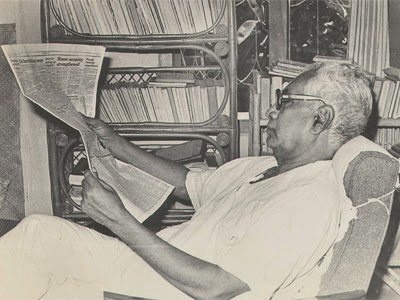
A Tribute and a Bibliography: Remembering People’s Historian Amalendu Guha (1924-2015)

- Bonojit Hussain and Mayur Chetia

স্বৰ্গত ৰুচি নাই, যাওঁ মই ভাটিখানালৈ
জুৱাৰী-মদপী-বেশ্যা-সিহঁতকো মেলত গোটাই
মনৰ চিতাৰ ছাই উৰুৱাই গাওঁ আশাবৰী :
আকাশত উৰা মাৰে জাকে জাকে ফিনিক্স চৰাই !

I have no desire for heaven,
Instead I go to the brewhouse,
Gamblers, drunkards, prostitutes - bringing them together
I sing of hope, sprinkling ashes from my soul’s pyre:
In flocks the phoenix flies to the sky.

- “মোৰ কবিতা / My Poetry” Amalendu Guha 1960

I


Prominent Marxist historian, revolutionary, poet and a litterateur from Assam – Dr. Amalendu Guha – passed away at the age of 91 in the wee hours of 7th May at his humble residence in Guwahati. Remaining true to his rationalist outlook, he had willed in 2005 that his bodily remains should be handed over to Gauhati Medical College for scientific research. Before and during Dr. Guha’s final ride to the Medical College, large numbers of people had gathered to pay their tributes at his residence, Assam Sahitya Sabha office in Cotton College State University premise and Ellora Vigyan Mancha office in Guwahati.

An unwavering pillar of left democratic movements in his home state, although Guha was mostly known as a historian in mainland India, his contributions and presence in the field of poetry and literature are also immense.

He presided over the History conclave and Poetry convention of Axom Sahitya Sabha in 1978 and 1994 respectively. Among his many other writings in Assamese and Bengali, his incisive travelogue on Afghanistan ‘Afghantistanot Ebhumuki’ (A Glance into Afghanistan) published in 1961 is considered to be one of the classics in Assamese travel writing. Apart from a revised edition published in 2002, the book has also been translated into and published in Tamil, Telugu, Malayalam and Kannada.

Despite publishing only two anthologies of poetry, Guha is counted among the most prominent modern poets of Assam. Guha has earned his place in the annals of Assamese literature as the poet of social consciousness, human sufferings and aspirations. His first anthology, called Luit Parer Gatha (in Bengali) was published in 1955 followed by his second anthology Tomaloi (in Assamese) published in 1960. Both these anthologies are resplendent tribute to Assam and the struggles and aspirations of its people.

In the lines of Neruda, Guha’s poetry resonate the universal themes of dreams, historical consciousness, poverty, political values, love, city life and nature; wherein aesthetics and politics mutually define each other. Markedly an optimist, for him poetry was one form of public salutation (ৰাজহুৱা সম্বোধন). A lover and balladeer of his land, Guha’s Assam is its splendid natural beauty, jhum farming, spring, rose chestnut, rivers, valleys, Oraons, Santhals, Mundas, laboring masses, Naga, Mizo, peaceful Manipur, mridang, cuckoo and weaving girls.

Talking of inspiration, writing in November 2000, Guha reminiscences that “around 1948 Hemanga Biswas gave me to read Pablo Neruda’s famous poem ‘Let the Rail splitters Awake’; inspired by it I wrote and published a long poem in Bengali corresponding to the situation prevailing in Assam as well as the world.” This poem composed and published in 1950 was a 136 lines poem called Luit Parer Gatha which was later used as the title of his first anthology with the same name.

Guha’s old friend Gautam Chattopadhyay recalls that sometimes in 1945 or 1946, when Guha was a BA student in Presidency College, they were travelling in a train to Guntur along with over a hundred fellow activists of Communist Party affiliated All India  Students’ Federation. Amidst discussions on politics and revolution, someone blurted out that “Amalendu writes wonderful poems!” Upon request to recite, tall, dark and lanky with a shock of bushy hair, Guha came forward and recited “Tram” his poem about a imagined journey from a Tram station to Dalhousie Square. The poem ends with this riveting line:

কন্ডাকটর ! বলতে পারতোমার আর আমারসাম্যের আর প্রাচুর্যের পৃথিবীটা কতদুর ?

Conductor! Can you tell us, how far is the world of equality and abundance?

Guha got involved in active left politics at the age of 14 as a high school student when he joined the All India Students’ Federation (Assam unit) in 1938/39, also around that time he started his engagement with Marxist study club “Progressive Union”.

1938 to 1940 was the time when leftist politics started making inroads into Assam. Many students around that time got attracted to Marxist ideas under the influence of Bengali leftists like Soumendranath Tagore, Kamal Ghosh, Biswanath Mukherjee and Amiya Dasgupta who had shifted to Assam for political work. As a result two different Marxist study groups took shape; those under the influence of Soumendranath Tagore gravitated towards “Radical Institute” which was associated with RCPI. Amiya Dasgupta and Kamal Ghosh took the initiative in the formation of “Progressive Union” which was associated with Student Federation. By 1942, during his Intermediate College days, Guha had already started to see himself as a communist. He remained an active member of Student Federation until 1947. He became a member of the Communist Party of India in 1943 and remained active as a party cadre until 1965 when he left his job at Darang College in Tezpur, Assam and moved to Gokhale Institute of Politics and Economics in Pune. But he continued his participation in politics and movements till his last years.

During the 1962 Indo-China war, within 15 days of his return to Darang College after finishing his PhD at Indian School of International Studies in Delhi, Assam Government arrested Guha under the Preventive Detention Act. From Tezpur, first he was brought to Nagaon jail and then to Guwahati jail. Within days around 52 inmates were flown in a special plane and shifted to special cells of Behrampur Jail in Orissa and were imprisoned there for six months. Among those 52 were prominent leftist intellectuals and activists of Assam like Bishnu Rabha, Baneswar Saikia, Achintya Bhattacharya, Biresh Misra, Gauri Shankar Bhattacharya, Jiban Kalita and Mohanlal Mukherjee.

In a 2004 interview on his 80th birth anniversary, Guha said that academically he always wanted to be based in Assam but the right prospect never came his way. Despite being one of the best candidates, he was denied a job at the newly established Gauhati University in 1948, and Guha strongly felt that he was denied the job because of his leftist ideology. That very year he joined Darang College, Tezpur, Assam as a lecturer of Economics and taught in the college till 1965. In between, from 1959 to 1962, he did his Phd from Indian School of International Studies, New Delhi and wrote his thesis on ‘Economic Transition in Afghanistan, 1929-1961’. From 1965 to 1973 he worked, first as a Research Fellow and later as a Reader, at the Gokhale Institute of Politics and Econmics in Pune. In 1973 he moved to Centre for Studies in social Science, Calcutta to teach Economic History and retired as a Professor in 1990. In between he also taught at the Delhi School of Economics in the years 1969-1970.

II
As a historian, Guha was primarily known for his work ‘Planters Raj to Swaraj: Freedom Struggle and Electoral Politics in Assam: 1826-1947’ published in 1977.  Till recently, it was the only academically informed work that was available on the region that professional historians could refer to, without hesitation. It was supposed to be a boring, factual and sarkari history of Assam legislative assembly, as part of a plan to write official histories of different provincial and central legislatures of India. It was commissioned by the Indian Council of Historical Research, as per the request of the Education Ministry of the Government of India, to commemorate the 25th anniversary of India’s independence. But with  Guha’s enthusiasm and ICHR director R S Sharma’s full support,  the book turned into a comprehensive history of Assam, touching as diverse topics as the national movement, labour struggles, peasant rebellions, politics of migration, effects of colonial economy  and so on. People have long forgotten the other books published in the series and yet Guha’s book has since become a classic, with thousands of students, researchers and activists still devouring its pages for rare insights and excellent handling of primary sources.

Tuesday, May 12, 2015

'गब्बर इज़ बैक' एन्ड ही इज मोर डैंजर

जावेद अनीस

शोले फिल्म के ओरिजिनल क्लाइमैक्स में ठाकुर द्वारा गब्बर को मारते हुए दिखाया गया था जिसे बाद में सेंसर बोर्ड की दखल के बाद बदलना पड़ा, सेंसर बोर्ड नहीं चाहता था कि फिल्म में ठाकुर का किरदार कानून को अपने हाथ में ले। लगभग चालीस साल बाद आयी “गब्बर इज बेक” के क्लाइमैक्स में सरकारी कर्मचारियों की बेधड़क हत्यायें करने वाले फिल्म के “हीरो” को किसी शहीद की तरह फांसी की सजा पाते हुए दिखाया गया है, यही वह फर्क है जो हम 1975 और 2015 के बीच की अपनी फिल्मों में पाते हैं। तो क्या यह परिवर्तन सिर्फ फिल्मों के मामले में हुआ है और हमारे समाज, संस्कृति और राजनीति के कोने इससे अछूते है? जरा ठहर कर विभिन्न क्षेत्रों के सितारों पर एक नज़र डाल लीजिये जवाब खुद बखुद मिल जायेगा,आज साहित्य के सबसे बड़े ब्रांड और सितारे चेतन भगत है, संगीत में हनी सिंह और मिक्का सिंह, सिनेमा में सलमान खान,अक्षय कुमार, अध्यात्म में बाबा रामदेव,आशाराम,राजनीति में नरेंद्र मोदी,केजरीवाल,अमित शाह, ओवेसी ब्रदर्स हैं। इस लिस्ट को देख कर स्पष्ट है कि अब हमारे नायक बदल गये है, अब वे दूध के धुले नहीं हैं और ना ही वे मूल्यों की परवाह करते हैं, श्रेष्ठ होने का पैमाना भी बदल चूका है। लीडरों, नायकों के साथ चलने की जगह उनके पीछे चलने की भेड़चाल की प्रवृति और ज्यादा हावी हो गयी है। 

हम उदारीकरण के दौर में हैं जहाँ अपने आप को बाजार में बनाये रखने के वास्ते सब को ब्रांड बनने के लिए संघर्ष करना पड़ रहा है,अगर एक बार भी आप ब्रांड बन गये तो सक्सेस हैं, फिर आप चाहे अन्दर से कितने भी खोखले और फर्जी ही क्यों ना हो और जो ब्रांड नहीं बन पाता है उसे हाशिये पर ही रहना है, फिर वह चाहे कितना भी प्रतिभाशाली क्यों ना हो, इस खेल का दूसरा नियम यह है कि ब्रांड वही बनता है जो मार्किट के रिक्वायरमेंट के हिसाब से फिट बैठता है, तभी तो ठीक पार्लियामेन्ट के पास आत्महत्या कर लेने वाला एक किसान न्यूज़ इंडस्ट्री के लिए एक ब्रांड बन जाता है जबकि वर्षों से ग्रामीण भारत के अलग–अलग हिस्सों में आत्महत्या कर रहे हजारों किसानों की आत्महत्यायें का कोई न्यूज़ वैल्यू नहीं बन पाता है, इन ब्रांड्स को ही रोल माडल के रूप में गढ़ा जा रहा है, लोगों में इनकी लत डाली जा रही है जो बाद में करोड़ों की संख्या में फैन्स बनते हैं, फैन्स होने की पहली शर्त अंधभक्त होना है। हमारे दौर के “रोल माडल” तानाशाह भी होते जिनका करोड़ों फैन्स आँख और कान बंद करके फालो करते है। सलमान खान से जुडी हालिया घटना इसका ताजा मिसाल है। 

1975 में आई फिल्म शोले का खलनायक गब्बर सिंह इस फिल्म का ही नहीं हिंदी सिनेमा का भी एक ब्रांड है, अब 2015 में फिल्मी परदे पर गब्बर एक बार फिर वापस आ गया है, इस बार वह विलेन नहीं हीरो है, हालांकि उसके कारनामे एक विलेन की ही तरह हैं लेकिन उसके विलेननुमा करतूतों का ना केवल महिमामंडित किया है बल्कि 'नाम विलेन का, काम हीरो का' जैसे पंच लाइन के साथ उसे स्थापित करने की कोशिश भी की गयी है। शोले फिल्म में गब्बर अगर अपने करतूतों पर शर्मिंदा नहीं भी था तो भी कम से कम उसने नायक बनने की कोशिश नहीं की थी। लेकिन गब्बर इज बैक का गब्बर एलान करता है “ना मैं सरकारी हूँ ना गैर कानूनी, ना मैं कोई नेता हूँ और ना ही कोई टेररिस्ट, काम से हीरो नाम से विलेन हूँ, मैं गब्बर हूँ”।

Friday, May 8, 2015

Farmers’ Struggles at Battleground Peripheries

- T Venkateshwarlu

The farmer suicide in the Aam Admi Party (AAP) rally at Delhi once again facilitated national level discussions on farmers’ suicide in the country. The rally was organized by the AAP against ‘Land acquisition Bill, 2014’. The farmer suicide is a big tragedy and very painful thing. Ruling party BJP and opposition party Congress blamed AAP to the farmer suicide. Delhi Chief Minister and AAP party leader Aravind Kejriwal accepted his mistake that to continue the meeting after the farmer suicide. Rahul Gandhi promised to the farmers that he will fight against land acquisition in the country. These statements and tragedies are all became the part of history. In the country farmers’ suicides have been happening for three decades without any interruption. From 1995 almost every 30 minutes one farmer is committing suicide. In these three decades nearly three lakh farmers were committed suicides. This is the according government data. In reality this number may be three times higher. In 2014 the rate of farmers’ suicide increased 26% comparing with previous year. No party did not take serious about farmers’ suicides and not wage struggles against the farmers’ major problems which are causing to the farmers’ suicides.

Many parties, organizations, forums and Non- government Organizations are waging struggles in various forms against ‘Land Acquisition Bill, 2014’. Modi government designed the ‘Land Acquisition Bill’ 2014’ by making changes to earlier Land Acquisition Bill, 2013. After curtailing the workers’ rights in the name ‘Sramevajayati’ Modi started his attack on farmers’ rights. Once again these actions proved that people took disastrous decision by electing Modi government. The tragedy is that many political parties did not respond and wage struggles against ‘Sramevajayati’ which is against workers and serve the industrialists interests. It shows that the parties’ interest in farmers’ vote bank in Indian politics.

In the new Bill Modi removed the consent and social impact assessment clauses in the Land Acquisition Bill, 2013. He wants to provide a lot of opportunities to the corporate companies to grab the farmers’ land and make huge profits. So, he removed the consent and social impact assessment clauses in the previous Bill. After the prolonged struggles for decades farmers succeed in getting ‘Land Acquisition Bill, 2013 which included progressive clauses such as 70% to 80 % consent of land owners which provides bargaining powers to the farmers to get better compensation to them at the time of land acquisition. The social impact assessment prevents corporate companies to make real estate business with the farmers’ land which were taken in the name of establishing industries and projects. There is no doubt that the Modi Land Bill is against farmers’ interests. He wants to serve the interests of the corporate companies. So, he thought that consent clause and social impact assessment may give troubles to corporate companies at the times of land acquisition. He never feels and hesitates to work for the corporate companies. Actually he proved himself that he is the best servant of the corporate owners. The corporate media is projecting him as a ‘savior’ of the country. He changed the Bill to fulfill the corporate companies’ aspirations. So, struggles against ‘Land Acquisition Bill, 2014’ are genuine and required. Any farmers’ family should not fell into vulnerable situation because of the land acquisition. Before taking farmers’ land for private companies, development projects and infrastructure projects, government should provide sufficient compensation and sustainable livelihoods to the land owners. Most of the parties which are waging struggles against ‘Land Bill, 2014’ largely confined to compensation. But compensation will not suffice to the farmers. We should demand that along with sufficient compensation land owners should be include as shareholders in the industries and development projects. No government has right to grab land from the farmers and distributes it to the corporate companies in the name of development. Farmers have the right on their lands. No government has to take their right on their lands. Only at the time of building cooperatives by themselves farmers may give their rights on the lands for collective benefit. The agriculture labourers and other people those who depend on lands and other natural resources for their livelihoods have to consider as the victims development projects at the time of land acquisition. Sufficient compensation has to pay them for losing their livelihoods opportunities. Even within the land acquisition arena those who are fighting against land acquisition are not demanding shareholder status of the land owners in industries and developmental projects.

Most of the ongoing farmers’ struggles are almost confined to the problem of ‘Land Acquisition Bill, 2014’. But we have to remember that this is one of the problems of the farmers’. Focusing more on ‘Land Acquisition Bill’ these parties put aside the other major burning problems of the famers’. Because of these problems small, marginal and middle class famers are facing serious crisis in agriculture. Famers have been gradually drowning in to the debt trap. Throughout the year farmers and their family members’ hard work did not get any reasonable income to survive. Instead of providing income to their hard work it gives huge debts and pushes them into more vulnerable conditions. These conditions are facilitating tragedy of farmers’ suicides across the country. Farmers are facing many serious problems such as lack of sufficient and timely financial assistance from the government banks, increasing prices of seeds, fertilizers and pesticides, lack of irrigated water facility, decreasing the soil productivity, lack of agricultural department services, lack of drying platforms and storages, lack of agriculture produce processing centers, marketing facilities to the produce and Minimum Support Price (MSP) to the agriculture produce.

Wednesday, May 6, 2015

नर्मदा के संतानों की रूहें

- जावेद अनीस

कई सालों से देश के किसान मुसलसल आत्महत्या कर रहे हैं लेकिन किसानों के इस देश में यह एक मुद्दा तब बन पाया जब एक किसान का बेटा लुटियंस की दिल्ली में ठीक हुक्मरानों के सामने खुदकशी कर लेता है। इसके बाद देश भर में भूमि अधि‍ग्रहण कानून और किसान आत्महत्या से जुड़े मुद्दे कुछ समय के लिए बहस के केन्द में तो आ जाते हैं लेकिन इसकी मियाद ज्यादा लम्बी नहीं होती है, व्यवस्था के चेहरे से गजेन्द्र के खून के छीटें अभी सूखे भी नहीं थे कि इधर मध्यप्रदेश में नर्मदा की संतानें अपने आप को रूह बनाने के लिए मजबूर हैं। खंडवा जिले के घोघलगांव में ओंकारेश्वर बांध क्षेत्र के डूब प्रभावित किसान पिछले11अप्रैल से नर्मदा की पानी में अपना शरीर गलाते हुए प्रतिरोध कर रहे हैं और सैकड़ों लोग पानी से बाहर से उनका साथ दे रहे हैं। यह वही नर्मदा नदी है जिसे यहाँ के लोग प्यार और सम्मान से “नर्मदा मैया” कर के बुलाते है और जो सदियों से उनकी जीवन रेखा रही हैं, लेकिन विडम्बना देखिये कि हमारे सिस्टम ने सैकड़ों सालों से लोगों की पालनहार रही नर्मदा की धारा को उसकी आँचल में बसे लोगों के लिए जानलेवा बना दिया है, यह विस्थापन बनाम तथाकथित “विकास” की लडाई है जिसमे जीत अक्सर “विकास” की ही होती है और जिनकी कीमत और नाम पर यह “विकास” होता है वह हार जाते हैं। भोपाल और दिल्ली में बैठे इस लोकतंत्र के हुकमरानों के कानों में जैसे लोहा जम गया है क्योंकि अपनी जान की बाजी लगाकर जल-समाधि ले रहे इन आवाजों को सुनने के लिए उन्हें पूरे 21 दिन लग गये। इक्कीसवें दिन बाद सरकार सत्याग्रहियों से मिलने के लिए पुनासा के तहसीलदार को अपने प्रतिनिधि के रूप में भेजती है जिसके नतीजे में ना तो कोई हल निकलना था और ना ही निकला। 

इससे पहले प्रदेश के मुख्यमंत्री शिवराज सिंह चौहान बीते 24 अप्रैल को खंडवा के चांदेल में पुनासा उद्वहन सिंचाई योजना का लोकार्पण के लिए आये थे लेकिन उन्होंने सत्याग्रहियों से मिलना मुनासिब नहीं समझा उलटे उन्होंने जलसत्याग्रहियों से कहा कि ‘निमाड़ अंचल के किसानों की आकांक्षाएं पूरा करनें के लिए ओंकारेश्वर बांध की उंचाई 191 मीटर तक करना जरूरी है और जो लोग पूर्वाग्रहों से ग्रसित होकर सत्याग्रह में शामिल हो गये हैं वे जनहित की आवश्यकता को समझते हुये इसे तत्काल समाप्त कर दें और निमाड़ के समृद्धि उत्सव में शामिल हो जायें।‘ अब मुख्यमंत्री महोदय को कैसे समझाया जाए कि बर्बादी के उत्सव में शामिल होना कितना दर्दनाक होता है, यह मुख्यमंत्री और उनकी सरकार के लिए निमाड़ का समृद्धि उत्सव तो हो सकता है लेकिन उन किसानों के लिए बर्बादी का दंश हैं जिनकी उपजाऊ जमीने इसकी भेंट चढ़ाई जा रही हैं। उनके लिए इस उत्सव में शामिल होने से अच्छा है कि वह अपने लोगों के लिए इन्साफ की उम्मीद में खुद के शरीर को उसी नर्मदा में गला दे जो उन्हें और उनके पुरखों की सदियों से जीवन और समृद्धि देती आई है।

सत्याग्रही यही तो कर रहे हैं, वे ओंकारेश्वर बांध के जलस्तर बढ़ाए जाने को लेकर जल सत्याग्रह कर रहे हैं, क्योंकि पिछले दिनों मध्यप्रदेश सरकार द्वारा ओंकारेश्वर बांध के जलस्तर को 189 मीटर से बढ़ाकर 191 मीटर कर दिया गया है जिससे उस क्षेत्र में आने वाले किसानों की कई एकड़ उपजाऊ जमीन डूब क्षेत्र में आ गयी है। किसानों का कहना है कि सरकार ने अपनी मनमर्जी से बांध का जलस्तर बढ़ा दिया है, इसके बदले सरकार द्वारा जो जमीन दी गयी है वह किसी काम की नहीं है। इधर लगातार पानी में खड़े होने से सत्याग्रही किसानों की हालत लगातार बिगड़ती ही जा रही अब उनके पैर लगभग गल चुके हैं ,वह बीमार भी हो रहे हैं,उन्हें सूजन,सर्दी- जुखाम, बदन दर्द हो रहे हैं,धूप भी लगातार तीखी होती जा रही है, डॉक्टरों ने सत्याग्रहियों के पैरों की जांच और इलाज की सलाह दी है मगर उन्होंने उपचार लेने से मना कर दिया है, इतना सब होने के बावजूद प्रदेश सरकार असंवदेनशीलता नजर आ रही है, लेकिन जल सत्याग्रही “लड़ेंगे, मरेंगे ज़मीन नहीं छोड़ेंगे", “हक लेंगे या जल समाधि दे देंगे” के नारों के साथ डटे हुए हैं। उनका कहना है कि सरकार हमें जीते जी मारने पर तुली हुई है इसलिए हमने भी ठान लिया है कि मर जाएंगे, मगर जमीन नहीं छोड़ेंगे।सत्याग्रहियों की मांग है कि पुनर्वास नीति के तहत जमीन के बदले जमीन और सर्वोच्च न्यायालय द्वारा निर्धारित मुआवजा दिया जाए। 

Wednesday, April 15, 2015

Rulers’ Inefficiency and Brutality end the Labourers’ Lives

T. Venkateshwarlu

On 7 April 2015 at early morning Andhra Pradesh police killed 20 red sandalwood labourers in the name ‘encounter’ at Sheshachalam forest area. According to police version, nearly 300 sandalwood labourers with red sandalwoods are found in ‘Chikatigala Kona and SacchinOdibanDa’ areas in Sheshachalam forest. The police warned the labourers but they attacked on police with their ‘sophisticated and dangerous’ weapons such as ‘axes and stones’. The police started firing to protect their lives from labourers attack. In that ‘war’ 20 labourers were killed in 20 miters range. Beside each labourer body, there is sandalwood, their shirt and footwear. Nobody is injured and arrested in hundreds of labourers even sandalwood did not recovered from other labourers those who escaped from the spot. This is the police narration of their ‘encounter’ story. It’s not a big puzzle to understand what happened in the Sheshachalam forest. Actually police killed 20 red sandalwood labourers with a strategy according to the rulers’ direction. The police did not have the courage and honesty to admit the truth that they did it. Because they thought it’s a best way to create fear among the sandalwood labourers to prevent sandalwood smuggling. The police and rulers want to cover their murderous act with a silly story. Their story may useful to the comedian cinema directors those who make comedy films based on nonsense scripts. 

Along with encounter story the police and rulers revealed some issues relating the red sandalwood smuggling. Those issues are that they arrested nearly 4000 sandal labouers and made propaganda in the village to create awareness about the ban on red sandalwood cutting. But they did not prevent the sandalwood cutting. Even some times they faced attacks by the labourers. But the arrested 4000 people are all belonged to labourers. The people who took the labourers for sandalwood cutting, who transport the sandalwood, who sell it in the international market, the officials who cooperate to the smuggling, the political leaders who protect the smugglers never arrested. These people did not get punishment. Only the labourers punished and put in jails those who came for this work to get some income for their families’ survival. Killing the sandalwood labourers is not the solution. It did not prevent smuggling. Actually the rulers did not have the commitment to eradicate the smuggling. If they have the commitment they would appoint efficient and honest officials and involve community in this operation. These officials would take stringent actions on smugglers including government officials and political leaders those who support and protect the smuggling. The sandalwood smuggling has been running for decades. Government has the information about smugglers, supporting officials and involving political leaders. The rulers would put vigilance in all ways in & out from the forest. The smugglers are not selling the sandalwood beside Sheshachalam forest area villages and the sandalwood is not small item like safety pin. They are selling sandalwood and that too they are transporting the wood to other countries through ships and flights. If Tamil Nadu is supporting to this smuggling activity, the Andhra Pradesh Chief Minister (CM) can discuss with the Tamil Nadu state CM and request to cooperate to end sandalwood smuggling. If the AP government did not get proper response from TN government it can put this issue before the center. AP rulers did not work in this way. Basically they did not have sufficient commitment to end the red sandalwood smuggling. This is the cause behind their inefficiency to prevent the smuggling. 

For the decades red sandalwood cutting is happening in Sheshachalam forest in Andhra Pradesh. Even nearby forest villagers used to cut the sandalwood to prepare home need material. The smuggling also has been happening for decades. In 2000 the government banned the sandalwood cutting and smuggling. Recently the sandalwood price has increased in the international market. Now in the international market one tone sandalwood price range Rs. 30 Lakh to 70 Lakh based on the quality of the wood. Last year AP government sold 4500 ton sandalwood for Rs. 1000 Crore and there are 8500 ton sandalwood reserves which were collected from the smugglers. AP government wants to sell this wood and it is eager to sell and earn money for the new capital city construction.

Friday, April 10, 2015

The Sin and the Error

- Ravi Sinha
…it takes an error to father a sin.
─ J. Robert Oppenheimer[1]
Future historians of India may well describe the past year as a year of political sin. This was the year in which the man who had earlier presided over the Gujarat Carnage was awarded the ultimate prize. The year saw an election that touched a new low marked by shallowness, vulgarities and lies – in no small measure by the labors of the man himself. Equally appalling have been the exertions of a large class of literati and glitterati to portray philistinism and inanities spouted by the most powerful mouth as wisdom of a visionary leader.
An entire country seems to have gone blind – unable to see that the emperor has no clothes. In this age of incessant television it should be obvious to anyone that the supreme leader does not carry conviction even when enunciating relatively higher banalities. He is at his natural best only when he mocks someone as a shehzada or slanders and vilifies an entire community through phrases such as ame paanch, amara pachees. It is an irony of history that the republic which had Nehru as its first prime minister has one now for whom even common mythology is too cerebral. He must vulgarize Pushpak Viman and Ganeshaand reduce them to quackeries of aviation and surgery.
Misfortune of the nation goes beyond the man. Forces of the diabolic housed in the hydra-headedParivaar can now accomplish the impossible. They can now occupy the political center stage without leaving off the lunatic fringe. They can adopt Gandhi without renouncing Godse; erect world’s tallest statue of a leader who had punished their forefathers for assassinating Gandhi; even co-opt Bhagat Singh without batting an eyelid about what he stood for and what he had to say about ideologies like theirs. They can further refine the art of doublespeak. Their “statesmen” can pave the way for corporate plunder and call it sab ka vikas (development for all). Their “ideologues” can advocate sab ka saath(inclusion of all) by exhorting Hindu women to give birth to a minimum of four children each, lest Hindus are reduced to a minority “in their own country”.
All second comings are farcical but none more so than the ones in which caricatures come alive. It would be a cliché to invoke Hitler’s example while describing the megalomania of the current prime minister. But it would not be entirely wrong. He is larger than life because no one else – whether in the government or in the party – is allowed to be visible even as a pygmy. The Cabinet of Ministers seems to have been demoted lower than the back-room boys who formulate policies, write speeches and take sartorial decisions for the supreme leader. Even those stalwarts of yesterday, who brought the party to the center stage by unleashing havocs such as the Ram Janma Bhoomi Movement, have been consigned to the political dustbin. But, rather than a second coming of Hitler, this sordid episode appears more like Chaplin’s Great Dictator coming to life. The prime minister’s relentless globe-trotting and hobnobbing with the rulers of the world without any significant diplomatic achievement or concrete gain for India so far – except, perhaps, getting the United Nations to declare June 21st as the International Day of Yoga – evokes memories of a scene in Chaplin’s movie where the dictator plays around with an inflated globe.
The prime minister’s telling the Japanese corporate honchos that he has money in his blood, his frequent recounting of uncountable things that India’s ancient wisdom can teach to the world, his recent observation that Indian grandmother’s recipes are enough to save humanity from environmental disasters and this makes India worthy of leading the global endeavor to save the planet, and other such gems that he scatters regularly across the globe, also bring to mind one of Kurosawa’s later movies,Kagemusha. In the movie a political decoy was deployed to impersonate a dying warlord who had kept his enemies in awe for long. The impersonator manages to get over his many temptations and actually learns to act like the warlord within the royal house as well as on the battle field.
That day may yet be far in this case. The body-language of the prime minister – while posing with a world leader or posing conspicuously to the camera when all other statesmen and diplomats around the table are busy with their papers – betrays the countenance of an imposter, even if anointed to the throne through a process every bit constitutional and politically legitimate. The acts and demeanor of the prime minister are constant reminders that Indian people have been tricked into committing a political sin. And the irony is that they have committed it against themselves.

Wednesday, April 1, 2015

And then they came for Oyasiqur Rahman Babu !

- Subhash Gatade
….It is not the young who are writing obituaries for the old,…I have seen the blood shed by so many young people steadily mounting up until now I am submerged and cannot breathe. All I can do is take up my pen and write a few articles, as if to make a small hole in the mud through which I can draw a few more wretched breaths. What sort of world is this ? The night is so long, the way so long….
( Lu Xun, Written for the Sake of Forgetting, P 234, Selected Works of Lu Xun, Vol III, Beijing)
Md Oyasiqur Rahman Babu , aged 27 years is dead. A travel agency executive by profession and a secular blogger by passion he was killed by radical Islamists in Tejgaon, Dhaka when he was going to office in Motijheel. The three assailants – who did not personally know each other – met just for planning the murder and then executed it with military precision.
Thanks to the courage exhibited by trans genders living nearby who caught hold of these murderers while the locals who watched the act before their eyes just dithered to move. Zikrullah, a student of Hefazat-e-Islam’s Hathazari Madrasa in Chittagong, and Ariful, student of Mirpur Darul Uloom Madrasa – were caught while the third member of the team, Abu Taher of Mirpur Darul Uloom, managed to flee the spot. The arrestees said they had killed Oyasiqur for writing on religious issues. It is a different matter that none of them had read his blog, they even did not know what blogging is, they  just executed the order issued by some mastermind. The duo told a police official :
“Our Hujur [religious teacher] told us that he [Oyasiqur] is an anti-Islamic person. It was our responsibility as believers to kill him. So, we killed him,”
It is a third killing by Islamists within a span of two years. First it was Ahmad Rajib Haider, who was killed by Radical Islamists in February 2013, when the historic Shahbagh movement was at its peak. Then came the turn of Avijit Roy, a Bangladeshi-American blogger, when death pounced on him last month, in Dhaka when he was coming out of the Ekushe Book Fair and now it is Washiqur Rahman.
All the three were premediated, copycat murders, one imitating the other. Cry of ‘hurt sentiments’, use of machetes, key role played by young Islamists associated with this or that Madarsa, brutality of the crime. Washqur’s case, they had tried to deface him in such a manner that it was difficult to even recognise him.
In an interview to NPR radio, Zafar Sobhan, editor of ‘Dhaka Tribune’ told that Oyasiqur Rahman Babu was part of a bloggers group called ‘Logical Forum’ – which carried lively debates on religion and fundamentalism and were critical of all religions.
He was known as Oyasiqur Babu on Facebook and used to write under pseudonyms on popular blogs. He had written several notes opposing irrational religious beliefs, superstitions and radical Islamists. An admirer of Avijit Roy who had recently changed his profile picture to the hashtag “#iamavijit” on a black background. His Facebook cover photo also displayed the hashtag #WordsCannotBeKilled. After Avijit’s death he had also mourned the killing of Ahmed Rajib Haider, known online as Thaba Baba and vowed to continue fighting.

Tuesday, March 31, 2015

शाह अब्दुल्ला, मेक्सिको की खाड़ी के परिंदे और सऊदी अरब की औरतें

- जावेद अनीस

Wajeha al-Huwaider demands the right to drive
वहाबीवाद का पोषक सऊदी अरब विश्व का सबसे मह्त्वपूर्ण और प्रभावी मुस्लिम देश है, यहाँ सऊद द्वारा 1750 में एक इस्लामी राजतंत्र की स्थापना की गई थी। सऊदी अरब विश्व के अग्रणी तेल निर्यातक देशों में शामिल है। यहाँ गठित होने वाली घटनाओं पर दुनिया की नजर बनी रहती है। सऊदी अरब के बादशाह शाह अब्दुल्लाह बिन अब्दुल अजीज अल सऊद का शुक्रवार को 90 वर्ष की अवस्था में निधन हो गया। अबदुल्ला की जगह अब उनके सौतेले भाई 79-वर्षीय सलमान सउदी अरब के नए शासक होंगें। शाह अब्दुल्ला की मौत के बाद उन्हें ‘मॉडर्न' सऊदी का जनक बताया जा रहा है, उनके तारीफ में कसीदे गढ़े जा रहे हैं, कहा जा रहा है कि उन्होंने महत्वपूर्ण राजनीतिक सुधारों के जरिये सऊदी अरब को आधुनिक बनाने की कोशिश की और अल कायदा के खिलाफ युद्ध में अमेरिका का साथ देते हुए जिहादी आतंक के खिलाफ अपना सहयोग दिया।

दरअसल सऊदी अरब एक बंद और तानाशाही की जकड़बंदी झेल रहा मुल्क है, यहाँ आधुनिक दुनिया के विचारों और लोकतांत्रिक, समतावादी सोच पर पाबन्दी है और जहाँ किसी भी तरह के असहमती की सजा मौत है, यहाँ सजायें भी मध्युगीन तौर-तरीकों से ही अंजाम दिए जाते हैं। वर्ष 1926 से शाह अब्दुल्लाह और उनके खानदान के लोग इस मुल्क पर तानाशाही के तौर हुकूमत कर रहे हैं जो अपने सत्ता को कायम रखने के लिए किसी भी तरह की विपरीत आवाजों को बेहरहमी से कुचलते रहे है। लोकतंत्र की एक सामान्य सी व्यवस्था के लिए उठी मांग को तुरंत घोटने में कोई कोताही नहीं बरती गयी। इस काम में इस्लाम की ओंट का भी बखूबी इस्तेमाल किया गया है। सऊदी अरब को मानवाधिकारों के उल्लंघन खासकर मौत की सजा और महिलाओं के साथ भेदभाव को लेकर अंतरराष्ट्रीय स्तर पर लगातार कड़ी आलोचना झेलनी पड़ी है। कुल मिलकर सऊदी अरब में दमन का स्तर असाधारण और इसके तरीके पूर्व आधुनिक है।

ह्यूमन राइट्स वाच के अनुसार साल 2014 के दौरान सऊदी सरकार द्वारा जिन 87 लोगों को मौत की सजा दी गई उनमें से ज्यादातर का सिर कलम किया गया था, और सवाल उठने पर अब्दुल्ला सरकार ने इसे शरीयत कानून के अनुसार की गई कार्रवाई बताते हुए जायज ठहराया था। पिछले साल अब्दुल्ला सरकार का एक शाही आदेश भी खूब चर्चित हुआ था जिसमें नास्तिकता को आतंकवाद की श्रेणी में रखते हुए इसका दोषी पाए जाने पर बीस साल तक की सजा और जुर्माने का प्रावधान किया गया था।

Monday, March 30, 2015

Acche Din Are Here Again!

- Subhash Gatade
..Government is set to defer indefinitely the implementation of notification for increasing the size of pictorial warning on tobacco products beyond April one, when it was to come into force. ..The notification regarding amendment to the Cigarettes and Other Tobacco Products (Packaging and Labelling) Rules, 2008 sought increase in the size of specified health warning from the current 40 per cent to 85 per cent of the principal display area of the package of tobacco products. [zeenews report]
The week gone by has brought back smiles on the face of Tobacco Corporates.

Thanks to the latest U turn by the Modi government, Acche Din would continue unabated for them. The non-transparent manner in which the decision was taken and the media was kept in the dark has raised further eyebrows. It was only on the evening of 24 th March that while talking to the media, the health minister J P Nadda had assured them that there is no rethink in the government on introducing pictorial warnings covering 85 per cent of packaging for tobacco products from April 1 and within few hours of this interaction he left for Beijing.

Definitely Nadda must have found time within that limited period to sign the order deferring the notification or as some journalists believe he had already signed it and was just pretending to avoid some inconvenient moments. It need be added that the said notification was brought in last October, when Nadda’s predecessor Harsh Vardhan – another RSS Swayamsevak – was handling the department. It was declared at that time that it would be effective by 1 st April. Not very many people could have the premonition that the government is not keen about it and would reverse the decision at an opportune moment.

It is worth emphasising that India was not the only country from South Asia, which had taken a decision about it. Pakistan as well as Nepal both had similarly taken some concrete steps in that direction. Welcoming their decision the ‘World Conference on Tobacco or Health‘ had even urged all the three to ‘stand firm against the tobacco industry pressure’. It had also suggested to them that to effectively reduce tobacco consumption and improve public health it can raise tobacco excise taxes which would make tobacco less affordable and can also generate additional revenue for government which can be utilised for healthcare.

If India would have gone ahead with its decision, then it would have been the first country in the world which had so much space allocated for the pictorial warnings. Now that is passe because of some ‘unexplained reasons’. Coming to pictorial health warnings on tobacco products there are enough studies available which vindicate that it makes the product less attractive and target smokers or users of tobacco products by providing them with information on tobacco-related health risks. Discussing reasons to introduce pictorial warnings on tobacco products ECL which is an Association of European Cancer Leagues makes few things clear. They are:
1) Eye-catching: this is in line with the saying that “a picture paints a thousand words” and the general belief that an image can often be more powerful than words on a page.
2) Informative: research in four countries showed that in Canada, where pictorial warnings include information about the risks of impotence, smokers were almost three times more likely to agree that smoking causes impotence compared to smokers from the US, UK and Australia.
3) Additional motivation for smokers who want to stop smoking: 44% of smokers in Canada said the pictorial warnings increased their motivation to quit smoking.
4) Less attractive for youngsters: 48% of Belgian smokers aged 15 to 17 think the new warnings make the packaging look less attractive.
                                                                   - European Cancer League
As things stand Nepal would be the only country from this part of South Asia which would go ahead with this decision. Like in many other such steps – which have been hailed by majority of countries, around which there is even a global consensus- India has decided to opt out this time again. Few months back (September 2014) India was one of the few countries which had abstained from a historic vote on violence and discrimination against sexual minorities. Not some time ago it had taken similar embarassing stance when it had supported Russian resolution which had opposed extending benefits available to spouses of UN employees to same sex couples under the specious plea of sovereignty. It had voted alongside Pakistan, Saudi Arabia and China.

Tuesday, March 24, 2015

Hashimpura : Who will Guard the Guards Themselves ?

- Subhash Gatade
Wait for justice to victims of Hashimpura has become much longer.
After around 28 years of the gruesome massacre allegedly by the personnel of the much feared PAC ( Provincial Armed Constabulary) for its biased approach , the Delhi court acquitted all 16 accused on ‘benefit of doubt due to insufficient evidence, particularly on the identification of the accused’.
There have been very few massacres in post-independent India which have shaken the civil society to the core and have propelled it to come forward and raise its voice. And the Hashimpura killings happen to be one such episode. One still remembers the words of the well-known journalist Nikhil Chakravarty who had visited the place along with few likeminded individuals and in his scathing write-up condemning the incident had compared the event with
“Nazi Pogrom against the Jews, to strike terror and nothing but terror in a whole minority Community”.
In fact, inquiry reports by organisations like the People’s Union For Civil Liberties (PUCL) and the People’s Union For Democratic Rights (PUDR) had clearly revealed that it was a case of barbaric cold-blooded murder by the PAC personnel. And forget public intellectuals or even reports by various civil liberty organisations, even the 1994 confidential report of the CBI had thrown light on the sordid saga.
“On 22nd May 1987 around 8.0 pm. they herded  40-42  ‘rioters’ in PAC Truck No. UR 1493 at Hashimpura overtly for taking them to Meerut Civil Lines or Police Lines. However, the Platoon Commander S.P.Singh drove to the Upper Ganga Canal Muradnagar(Ghaziabad) ignoring their protests. On reaching there they started to unceremoniously  shooting them down. When a few tried to escape they were shot down on the spot and their bodies were cast into the Canal. Rest of them were taken to the Hindon canal and there the sordid show was reenacted . ‘’
But as the survivors of this case and their silent supporters are trying to pick up pieces from the decision of the courts’ and have expressed their resolve to continue their fight for justice, perhaps all these words provide no consolation.
The day after the judgement one could witness anger on the streets of Hashimpura and many protesters even raised black flags on their houses and also took out a procession. One of the survivors of this incident even expressed his disillusionment with the words that ‘Muslims can never get justice in this country.’
Looking back the massacre also happens to be a case where one finds all the mainstream political parties which ruled UP during this period of 28 years colluded in one way or the other to save the perpetrators and thwart the process of justice. You name a party and you can discover the sinister pattern of connivance between the different actors in the state – ranging from the polity to the executive.

Thursday, March 19, 2015

[P.A.D.S Statement] The Dimapur Lynch Mob and Violence of Hurt Sentiments

Statement by People's Alliance for Democracy and Secularism [P.A.D.S]

On 5th March a man was dragged out of the Central Prison in Dimapur in Nagaland by a mob. He was paraded naked on the streets of the town for hours while the crowd beat him up, took pictures and uploaded them on the internet. After seven kilometers of public torture he was tied to the City Clock Tower in the center of the town and beaten to death. Nine days ago, the man was accused of raping a Naga college student, and was arrested for that. The crime became the news of the town a week later. A demonstration by Naga Students’ Federation was held on 4th March against the rape. In public discourse the man, actually a Bengali speaking Assamese Muslim from the Cachhar region, became an IBI (illegal Bangladeshi immigrant) because of his religion and language. One prominent newspaper headlined the news with ’IBI rapes woman in DMU’ on its front page. Naga civil society organisations brought out statements calling for justice, but also detailing the menace of IBIs in the state, and how they would take over Nagaland if Nagas do not stand up against the crime. Demands were made to hand over the man to the community to be tried under customary Naga laws. Photocopies of the man’s picture were widely distributed. Blogs were filled with aggressive comments. When the moderator of one blog stopped putting up angry comments, another one by the name Naga Spears came along to keep the cyber fire burning.

It is not for the first time in the Indian sub-continent that crowds of citizens, otherwise ordinary in every sense, have brutally killed unarmed human beings. Communal riots of 1947 were perhaps the worst in human history. In independent India instances of unimaginable savagery abound as in Nellie 1983, Delhi 1984 and Gujarat 2002. The immediate context of these killings were different from each other, but they were all done in the name of some community interest, or its corollary, for teaching a community a lesson.

The allegation of rape was only a trigger for the lynching in Dimapur. Gnawing divides along community boundaries are a regular source of suspicion and every day forms of violence all over the North-East. Illegal Bangladeshi immigrant is a convenient label used against Bengali speaking Muslims, most of whom had actually migrated before independence to riverine areas, and are as much of Indian citizens as anyone else. Along with Adivasi Tea Tribes they are among the poorest in the North East. From Bodo areas in the lower Assam to the international border with Myanmar they are a regular target of xenophobic and communal politics. During an election rally for the current Lok Sabha Mr Modi had famously declared that all illegal migrants from Bangladesh will be sent back as soon as BJP government is formed. In other parts of India too the bogey of illegal Bangladeshi immigrant is a convenient ploy for communalism and xenophobia. Apparently, during the time of BJP government in Delhi, police stations in the city were given monthly quotas to ’catch’ and deport poorer Bengali speaking Muslims who are mostly rag pickers and have valid documents. Even people who may not be communal otherwise, turn ultra nationalist on the issue of supposed migration from Bangladesh. It is not difficult to imagine the reaction in the country if the person killed by the mob in Dimapur had actually been a Bangladeshi.

In many parts of the Norht-East including Nagaland political struggles against the Indian state have been on for more than five decades. The political landscape here is littered with armed ethnic mobilisations which have slid from collective grievances of oppressed communities to random and targeted killings of ’outsiders’. Such mobilisations also act to curtail the democratic rights of those internally oppressed within the community, most commonly women. These struggles may have legitimate reasons, but no one has a right to kill an unarmed human being, irrespective of whether he/she is an accused, or is an illegal immigrant.

Monday, March 16, 2015

On The Interrelationship between Bovine and Human Beings

- Subhash Gatade
”in our religious scriptures ( Puranas) life of a cow is more important than any number of people” ( Puranon me insaan se jyada gay ko mahtv diya jata hai)
- Giriraj Kishore, Vice President of VHP,
On the public lynching of five dalits, October 2002
BJP Haryana chief Ram Bilas Sharma has promised to treat cow slaughter as a crime as heinous as murder. If elected, he said at the manifesto release function…
 TNN | Oct 3, 2014, 05.06AM IST
There is a competition of sorts between BJP ruled states to fulfil what a Haryana leader said ‘ to fulfil Modiji’s dream’. Close on the heels of Maharashtra government’s getting clearance to ban cow slaughter, there is news in a section of the press that the government in Haryana would table a similar bill in the assembly.
Sharing few snippets of the bill and comparing it with punishment of other offences, a newspaper report tells us that if the offence is insult to modesty of women the maximum jail sentence would be one year or fine, if it is molestation then it would be two years or fine, for theft the maximum jail term would be three years, for assault it would be 3 months or fine,  and for causing grievous hurt it would be maximum seven years. (Times of India, 14 th March 2015) and if it is beef in any form then it would be punishable by upto ten years in jail.
Once the bill is passed by the assembly and ratified by the President, Haryana perhaps would reach number one position as far as extending punishment for this act. If for a similar act Maharashtra has stipulated 5 years punishment, M.P. has decided to have 7 years punishment, Haryana plans to give 10 years. People would very well remember that during campaign for assembly elections the BJP had promised to make a stringent law ‘equalling cow slaughter with murder’.
Undoubtedly, Giriraj Kishore, (1920-2014) the octogenarian leader of Vishwa Hindu Parishad, an affiliated organisation of the RSS and a veteran of the Ram Janambhoomi movement, would have definitely rejoiced over this proposal about increase in quantum of punishment, in a state ruled by a fellow RSS Pracharak. He would have felt that the state is slowly inching towards ‘glory of ancient India’ which he had shared with people as far as interrelationship between bovine and human beings is concerned when the state had witnessed public lynching of five dalits by a blood-thirsty mob in Dulina, Jhajjar.
Not very many people would remember today his words when those hapless five dalits who were under police custody- who were engaged in trade in hides and were carrying a dead cow in a minitruck- were brutally killed by a few hundred/thousand mob of people, in the very presence of many senior officials of the police deptt as well as administration. (12 th October, 2002). It was an event very much on the lines of the recent Dimapur killings and in some ways worse than it. Instead of condemning this act of lynching of fellow human beings and demanding strict action against the perpetrators and at least expressing sympathies towards the departed victims Giriraj Kishor had in an obtuse way tried to ‘rationalise’ this clear crime against humanity by pontificating on how religious scriputres treat human beings vis-a-vis the bovine. Perhaps his reaction had also do with the fact that many activists of different Hindutva Supremacist organisations were found to be involved in committing the crime and this veteran of Ram Janambhoomi movement – who had started his social-political life as a RSS worker – wanted to send a message to the powers that be.

Tuesday, March 10, 2015

Goodbye Secularism! Enter Theocracy!!

- Subhash Gatade

Understanding the yet unfolding ‘Dietary Fascism’

Image Courtesy : bollypedia.in

To the question whether the Hindus ever ate beef, every Touchable Hindu, whether he is a Brahmin or a non-Brahmin, will say ‘no, never’. In a certain sense, he is right. From times no Hindu has eaten beef. If this is all that the Touchable Hindu wants to convey by his answer there need be no quarrel over it. But when the learned Brahmins argue that the Hindus not only never ate beef but they always held the cow to be sacred and were always opposed to the killing of the cow, it is impossible to accept their view…
B. R. Ambedkar 1
“Did the Hindus never eat Beef?” Dr Ambedkar has dealt with this specific issue holistically in his various writings and has also tried to link it with emergence of ‘untouchable’ castes.
At a time when the saffrons are keen to appropriate Ambedkar  – who had time and again cautioned his followers about the dangers of Hindu Raj 2 and appealed to them to fight the twin enemies of  Brahminism and Capitalism – and present him as someone who not only endorsed the Hindutva project but also opposed beef eating as cow was sacred to Hinduism, it would be opportune to pose this question afresh before them.
You may encounter either complete silence or sudden eruption supposedly to ‘drown’ the question itself. Either way they would demonstrate that they very well understand that getting into debate over this issue has the possibility and potential of subverting the very edifice built by them which blames ‘outsiders’ especially Islam or Muslim rulers for many of the ills of our society. They very well know that there is a world of difference between the idea of Hindutva promoted by them and what Ambedkar thought.
Taking into consideration this complete dissonance in both viewpoints and keen to lure Dalit masses in their dubious project of Hindu consolidation, the saffrons have devised a clever strategy of carving out a sanitised version of Ambedkar devoid of his revolutionary vision and bracketing him in its pantheon of leaders – comprising of Hedgewar, Savarkar, Golwalkar etc – whom it considers as ‘Pratah Smaraniya‘ (worth remembering in the morning) . And glossing over his direct attacks on Hinduism and his declaration in mid-thirties that ‘he may be born a Hindu but would not die a Hindu’ and implementing it ultimately by accepting Buddhism along with lakhs of his followers few months before his death, they are keen to project him as a Hindu social reformer to befool the Dalit masses.
For a politics which is based on exclusion and hatred of ‘others’ one cannot expect anything better. Selective amnesia vis-a-vis his contributions is an integral part of their project of adopting or assimilating Ambedkar to suit needs of their divisive politics.
Interestingly this approach of selective appropriation or remembrance of leaders who were not quite amenable to the project of Hindu Rashtra is not limited to them only. It is extended even to those personalities/leaders also whose worldview largely converges with the saffrons themselves.
Take the case of Swami Vivekanand, who is much celebrated and glorified in the Hindutva circles as one of their own. Not a day passes when Sangh and the plethora of affiliated organisations forget to lay claim to his legacy. While the RSS shies away from probing the past Vivekanand is more objective in revisiting it and thus one discovers that he is also not on the same page on the issue of beef eating with them.