
https://www.youtube.com/watch?v=IOCghdB2d5g


https://www.youtube.com/watch?v=IOCghdB2d5g


https://www.youtube.com/watch?v=IOCghdB2d5g


Speaker :
Chandran Nair
Author, Thinker and Political Analyst
Founder and CEO of the Global Institute For Tomorrow (GIFT)
Date and Time :
Sunday, 3 rd May, 2026, 6 PM (IST)
Join Zoom Meeting
https://us02web.zoom.us/j/83945588791?pwd=k23qcCsRbSLwvl0MjtxstVpRYJDBOF.1
Meeting ID: 839 4558 8791
Passcode: 837048
Abstract:
In a conversational and interactive mode, the speaker will broadly be covering the following aspects of the theme:
1. Neighbourhood, Geopolitics, New World Order - The troubled relations between the two Asian giants have, by now, a history of several decades. In India, the constraints of domestic politics (largely flowing from liberal democracy and competitive electoral politics) appear to make it difficult for the Indian rulers to serve India's strategic interests and to formulate an appropriate foreign policy. How should India deal with the strategic challenges arising from the emerging New World Order?
2. Political Economy for India – India is often projected to emerge as the next economic powerhouse of the world, but the facts on ground pose many challenges. The path to export-led growth as traversed by China appears to be closed for India. Furthermore, a strong State that can guide and force private capital to work in national interest is impossible in the liberal democratic and capitalist India. How to visualize a political economy suitable for India?
3. Woes of Liberal Democracy – Competitive electoral politics often activates the social, religious and sectarian fault lines of Indian society. It has, for example, paved the ground for the rise of the Hindutva forces. What can be done about such challenges thrown up by liberal democracy?
4. Civilizational Discourse – China and India are often cited as the two glorious and largest ancient civilizations. China is cited as the civilizational state that has managed to tame modernity for its own ends. How can India accomplish something similar in its own way?
Speaker :
Chandran Nair is the founder and CEO of the Global Institute for Tomorrow, an independent Pan-Asian think tank that explores the dynamic relationship among business, society, and the state, as well as the rules governing global capitalism
Nair was born in Malaysia, he studied chemical engineering in the UK, at 28, he joined the anti-apartheid movement in South Africa, later earned a master's degree in environmental engineering from Bangkok.
He has authored / co authored many books, here is a representative list of his publications : Understanding China : Governance, Socio-Economics, Global Influence (2026) ; Dismantling Global White Privilege : Equity for a Post-Western World (2022) ; The Sustainable State: The Future of Government, Economy, and Society (2018) ; Consumptionomics: Asia's Role in Reshaping Capitalism and Saving the Planet (2011) ;
He is also the creator of The Other Hundred, a non-profit global photo journalism initiative to present a counterpoint to media consensus on some of today's most important issues.
Chandran was chairman of Environmental Resources Management (ERM) in Asia Pacific until 2004, establishing the company as Asia’s leading environmental consultancy.
Chandran has served as Adjunct Professor at the Hong Kong University of Science and Technology and the Lee Kuan Yew School of Public Policy in Singapore. He is a Member of the Executive Committee of The Club of Rome and a Fellow of the Royal Society of Arts.
- New Socialist Initiative (NSI)
Abstract :
The unipolar world that came into existence at the end of the Cold War is on the way out and a new world order, potentially a multipolar one, is in the offing. This epochal change, as evidenced in the miraculous rise of China and the re-emergence of Russia on the world stage, appears to have gained acceleration with the war in West Asia in which the Iranian nation has handed an astonishingly courageous response to the aggressors. A broad framework to understand this epochal transition was presented in a study group by Comrade Ravi Sinha.
Part 1:

https://www.youtube.com/watch?v=ZZzC-ak1I6Q
Part 2:

https://www.youtube.com/watch?v=nbkaQ3zrVck
Part 1 of this video contains the basic presentation followed by further elaboration of the argument in the Q/A session in Part 2.
Date: 05 April 2025
New Socialist Initiative (NSI)
Speaker: Professor Atul Kohli
Abstract:

Democracy Dialogues Series 42
Organised by New Socialist Initiative
Theme :
India Under Modi: Shrinking Democracy, Growing Inequalities
Speaker:
Professor Atul Kohli
David K.E. Bruce Professor of International Affairs at Princeton University, USA
Time and Date :
7 PM (IST)
Sunday 25 th January 2026
Join Zoom Meeting :
https://us02web.zoom.us/j/84840793414?pwd=Km2sDmvf0XQMY0ISoGKN7emfjzPNLO.1
Meeting ID: 848 4079 3414
Passcode: 168537
The meeting will also be live streamed at Facebook ( facebook.com/newsocialistinitiative.nsi).
----------------
Abstract:
Modi’s rule in India is characterized by shrinking democracy and growing economic inequalities. The presentation will focus both on the rise of Modi and on Modi’s ruling record. The following points will be emphasized: growing economic inequalities under Congress governments after 1991 fractured the party's voter base, paving the way for Modi's rise; religious polarization and corporate power have grown simultaneously under Modi; India’s billionaires thrive amid the democratic decline; institutional checks have been eroded and the opposition has been fractured: the judiciary, media, and election bodies have failed to counter executive power; and there is little evidence to suggest a superior economic record in India after 2014: industrial growth has been sluggish, job creation minimal, and welfare spending flat.
About the Speaker: Professor Atul Kohli is a world-reknowned political scientist. He is the David K.E. Bruce Professor of International Affairs at Princeton University. His principal research interests are in the area of political economy of developing countries. He is the author of India Under Modi: Changing State and Society (with Kanta Murali), (2025); Greed and Guns: Imperial Origins of the Developing World, (2022); Imperialism and the Developing World: How Britain and the U.S. Shaped the Global Periphery (2020); Poverty amid Plenty in the New India (2012) (a Foreign Affairs Best Book of 2012 on Asia and the Pacific); State-Directed Development: Political Power and Industrialization in the Global Periphery (2004) (winner of the Charles Levine Award (2005) of the International Political Science Association); Democracy and Discontent: India's Growing Crisis of Governability (1991); and The State and Poverty in India (1987). He has also edited or coedited ten volumes (most recently, Business and Politics in India, 2019; and States in the Developing World, 2017) and published some sixty articles. Through much of his scholarship he has emphasized the role of sovereign and effective states in the promotion of inclusive development.

Democracy Dialogues Series - Lecture 40
Organised by New Socialist Initiative
Theme :
South Asian Futures in a Tri-Polar World
Speaker :
Professor Pervez Hoodbhoy
Eminent Physicist, author, public intellectual
Time and Date :
6 PM (IST)
Sunday , 27 th July 2025
The lecture will be held on zoom and will also be live streamed at facebook.com/newsocialistinitiative.nsi
The Cold War and the collapse of the Soviet Union are long behind us, and we're now hurtling toward a tri-polar world dominated by America, Russia, and China. These three powers vy to shape global influence, often competing but sometimes colluding. As the saying goes, "When elephants fight, the grass gets trampled." So, the central question for this lecture is: What path are the nations of South Asia—including Afghanistan and Iran—likely to take? What alternatives and tools do they possess to navigate this landscape? Most importantly, what vision of society and power should guide them toward a viable future?
Speaker :
Professor Pervez Hoodbhoy is a nuclear physicist, a prominent activist, in particular concerned with promotion of freedom of speech, secularism, scientific temper and education in Pakistan; founder-director of The Black Hole in Islamabad, and an author. As the head of Mashal Books in Lahore, he leads a major translation effort to produce books in Urdu that promote modern thought, human rights, and emancipation of women.
Prof Hoodbhoy received his undergraduate and graduate degrees from MIT and has taught physics and mathematics at Forman Christian College-University in Lahore, and previously taught physics at Lahore University of Management Sciences (LUMS) and the Quaid-e-Azam University (QAU) in Islamabad.
He is a recipient of the Baker Award for Electronics and the Abdus Salam Prize for Mathematics. He was visiting professor at MIT, Carnegie Mellon University, and the University of Maryland. In 2003 he was awarded UNESCO’s Kalinga Prize for the popularization of science.
Here is a list of a few of his publications :
- Pakistan: Origins, Identity and Future, published by Routledge (London, New York), 2023.
- Confronting the Bomb – Pakistani and Indian Scientists Speak Out, (edited) Oxford University Press, 2013.
- Education and the State – Fifty Years of Pakistan, (edited) Oxford University Press, 1998.
- Islam & Science: Religious Orthodoxy and the Battle for Rationality, published by ZED Books, London, in 1991 with translations in Turkish, Malaysian, Indonesian, Arabic, Spanish, Sindhi, and Urdu.
- Proceedings of School on Fundamental Physics and Cosmology, co-edited with A. Ali, World Scientific, Singapore, 1991.
Part 2: दलित, स्त्री, वाम जैसे आंदोलन भारतीयता में असफल
Part 3: भक्ति आंदोलन से ज्ञान, तर्क, दर्शन, सरलता को खदेड डाला

Organised by New Socialist Initiative
Theme : Class, Inequality, and the Current Political Moment in China and India
Speaker :
Prof Vamsi Vakulabharanam
Co-Director of the Asian Political Economy Program and Associate Professor of Economics at the University of Massachusetts, Amherst
Time and Date :
6 PM (IST), Sunday , 11 th May 2025
Join Zoom Meeting
https://us02web.zoom.us/j/85477229764?pwd=4mh7CbZWlpgC8h0OdVxUi0aIMaOGfW.1
Meeting ID: 854 7722 9764
Passcode: 684127
The meeting will also be live streamed at Facebook ( facebook.com/newsocialistinitiative.nsi).
-----------------------
Theme: Class, Inequality, and the Current Political Moment in China and India
This talk is based on a recently published book by the Oxford University Press – Class and Inequality in China and India, 1950-2010. China and India have seen a significant revival over the last three decades in terms of their place in the world economy. Two and a half centuries ago, they contributed 50 percent of the world output; after suffering a decline thereafter, their share fell to a paltry 9 percent in 1950 but has since resurged to over 25 percent today. Their growth and inequality experiences diverged for three decades following India's independence (1947) and the Chinese revolution (1949). Thereafter, there are remarkable underlying similarities in the experiences of both countries, especially in terms of their rising inequality patterns analyzed through a class lens. Vamsi demonstrates that the mutual interconnectedness between Chinese and Indian growth and inequality dynamics and the transformation and evolution of global capitalism is key to understanding the within-country inequality dynamics in both countries over the 1950-2010 period. Based on this analysis of class-based inequalities, Vamsi reflects on the current political moment in both countries, from a political economy perspective.
About Speaker : Prof Vamsi Vakulabharanam
Vamsi Vakulabharanam is Co-Director of the Asian Political Economy Program and Associate Professor of Economics at the University of Massachusetts, Amherst. He has previously taught at the University of Hyderabad (2008-14) and the City University of New York (2004-07). His recent research focuses on inequality in India and China and the political economy of Indian cities through the axes of gender, caste, class, and religion. In the past, he has also worked on agrarian change in developing economies, agrarian cooperatives, and the relationship between economic development and inequality. Vakulabharanam was awarded the Amartya Sen award in 2013 by the Indian Council of Social Science Research.
We have by now devoted several sessions to mapping the millennial trajectory of the Bhakti Movement across the history and the cultural geography of the subcontinent. Starting with the Tamil lands in the 7th century we followed Bhakti performing the pradakshina of the cultural landmass of the subcontinent, crossing the Vindhyas in its northward journey sometime in the 13-14th century. Our endeavour has been to understand the role of Bhakti in shaping the cultural and the civilizational mind of India. This, in turn, has been motivated by task of making sense of the role this mind plays in contemporary politics and in the rise of fascistic Hindutva in recent decades.
As we stated in the proposal to a previous session, we seek to understand the impact of Bhakti at two different time-scales. On the shorter time-scale of contemporary politics one looks at the phenomenon of communalism. The mainstream of the anti-colonial national movement considered Bhakti Movement as the harbinger of religious tolerance and syncretism that would help evolve the Indian brand of secularism. The subsequent history, however, paints a mixed picture. A social fabric and a cultural mind weaved by the Bhakti ideologies do not offer the kind of resistance to communalism and sectarianism as was expected of them. In our previous sessions we mainly stayed with evaluating the impact of Bhakti at the political-historical time-scale characterized by the problem of communalism and the rise of Hindutva.
On a longer – millennial – time-scale, however, one can evaluate the Bhakti phenomenon in the civilizational context. One can ask something like the Needham Question – why did the Indian civilization, despite its glory and accomplishments in the ancient and the medieval periods, fail to realize its cultural and scientific potentials? Why was it defeated often and why was it eventually colonized? Why did the West forge ahead, why has India lagged behind? Did the cultural mind and social ethos prepared by the Bhakti Movement play a role in the civilizational decline of India? These are very large questions not amenable to easy answers. But one must prepare to wrestle with them as they are of crucial importance for imagining and fashioning a desirable future for India. In this session, we finally arrive at the task of outlining a framework for asking and answering these questions.
For this purpose, we propose to take help of two large concepts – one of Axiality and the other of Modernity. The idea of axial revolutions was proposed for the civilizational breakthroughs that happened in the middle centuries of the first millennium BC in several different and unconnected societies – Judea (land of the Old Testament in the era of prophets), Greece (of pre-Socratic philosophers as well as of Socrates, Plato and Aristotle), China (of Confucius, Mencius and others) and India (of Upanishads, six systems of philosophies, and of Buddha) being the prime examples. We will briefly go through the idea of Axiality and see how we can understand it in the sequence of human cultural and cognitive evolution progressively from the mimetic (pre-linguistic, primarily based on gestures, rituals and body-language) to the mythic (linguistic but largely oral and narrative-based) to the theoretic (rational, abstract, normative and self-reflective). We will try to locate the Indian antiquity in the sequence of cultural evolution.
We will then make a millennial jump and outline the idea of Modernity, which can, in this context, be seen as a new kind of axial transition. The first axial transition did take the civilizations concerned from the mythic era to the theoretic era, but it still depended on the idea of the transcendental to reorder life in the realm of the mundane. The transition to Modernity, for the first time in human history, brings human autonomy to the centre-stage of history and civilization. Elimination of human dependence on the super-natural and on the transcendental is brought explicitly on the agenda and an objective and scientific knowledge of the cosmos is deployed into the service of human emancipation and freedom.
While the Indian civilization was a key example of the axial breakthrough two and a half millennia ago, its transition to Modernity has been faltering and patchy. While this may be true for many civilizations, it is especially disconcerting in the case of India which has had such a glorious antiquity at least in the domains of the mythic and of the theoretic. Of course, entire history of the intervening two millennia culminating in the colonial subjugation at the hands of the modernist imperialists is implicated in the complex and faltering progress of Modernity on the subcontinent and it cannot be explained on the basis of one cause or developments in any single arena. But one can be reasonably certain that the developments in the cultural-religious-civilizational arena play an important role in the civilizational transitions and transformations. The role of the millennial march of Bhakti must be assessed and evaluated in this context.
We will also engage with the theoretical issues that arise in this context of the materialist explanation of historical progress. There is no doubt that the historical breakthroughs and the transitions from one stage of history to the next happen through the push of advancing forces of production and, in this respect, the cultural-civilizational transformations are correlated with the developments in the material conditions of life. But there is a significant difference between the respective dynamics of systems and civilizations. While history progresses through replacement of one system by the next, in case of civilizations the older ones never entirely go out of existence. The older ones merely become the subterranean layers on which new layers arise or get deposited. The mimetic-ritualistic and the mythic, for example, have not disappeared from human civilization even after the axial-theoretic and the modernist-scientific stages have become increasingly entrenched.
Once again, I am not sure whether all this can be covered in one session even at the level of very sketchy outline of the argument. But the idea is to start thinking about these issues which, abstract and theoretical as they may sound, are of critical importance in making sense of contemporary politics and history.
Select Bibliography

31th Lecture
Theme: The Political Economy of New India
Speaker: Dr. Parakala Prabhakar(Author, economist and public intellectual)
Date and Time: 26 May 2024 at 6PM (IST)
Relentless in exposing the sinister nature of the communal politics of the current ruling dispensation and meticulous in exposing the voodoo economic policies pursued by them which are disastrous to the Indian economy, Dr Parakala Prabhakar is going to speak on ‘The Political Economy of New India’ in this lecture.
Dr. Parakala Prabhakar, is an author, economist, and public intellectual.
He served as Communications Advisor, held a cabinet rank position in Andhra Pradesh Government between July 2014 and June 2018. He was also a former spokesman and one of the founding general secretaries of Praja Rajyam Party.
For several years he presented a current affairs discussion programme on television channels of Andhra Pradesh. His programmes included Pratidhwani on ETV2 and Namaste Andhra Pradesh on NTV .
His book of essays ‘The Crooked Timber of New India : Essays on a Republic in Crisis‘ was widely discussed.
Dr Parakala completed his doctorate from the London School of Economics. He did his Master of Arts (M.A.) and Master of Philosophy (M.Phil.) from Jawaharlal Nehru University (JNU), New Delhi.
Q & A session Part 2
Q & A session Part 3
Outline

30th Lecture
Theme: Secularism in a Religious Mode ?- Gandhi's Practice during Partition '
Speaker: 'Prof Sucheta Mahajan, Professor of History Centre for Historical Studies, JNU ( retd)
Date and Time: 28 April 2024 at 6PM (IST)
The talk looks at the practice of Gandhi in his struggle against communalism in the years leading up to Partition. This is a hugely controversial subject with polarised positions taken by his followers and critics.
The perspective of the talk emerges from Gandhi’s oft quoted but not heeded statement, My Life is My Message. The talk is a reading of a life text in this sense: Gandhi’s mission in Noakhali to mend the social fabric torn by communal riots and spread of communal ideology.
Gandhi’s search for a way out may offer some insights to those sharing his concern for a secular, plural society and polity today.
Professor at the Centre for Historical Studies, Jawaharlal Nehru University, till the end of February 2023, Professor Mahajan has been visiting professor and Fellow at different International and National Institutions.
She was member of the prestigious international research projects such as SPECTRESS and CHCI-MELLON Crises of Democracy, Global Humanities Institute. She has authored and edited many books on India’s Independence Struggle, Partition, Challenge of Communalism, Composite Culture etc
RSS, School Texts and the Murder of Mahatma Gandhi- The Hindu Communal Project (with Aditya and Mridula Mukherjee) Sage Publications, 2008.
Composite Culture in a Multi-Cultural Society (Co-edited with Bipan Chandra), Pearson India & National Book Trust, New Delhi, 2006.
Independence and Partition: The Erosion of Colonial
Power in India, Sage Publications, New Delhi, 2000.
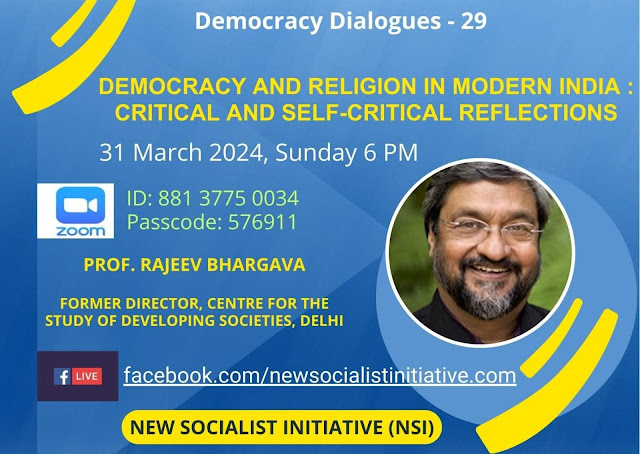
"It is widely accepted that 'secular' is an alien category in India. This is too simplistic a view. But even if we agree with it, how come no one has asked if 'religion' is alien to India? My claim is that it is or at least it is as foreign to India as secular is. What are the implications of this thesis? What have been the consequences of religionization on Indian society and polity? How has it shaped Indian democracy? In my presentation, I shall expand these views and show why India needs secularism and in what form."
Renowned political theorist and former director of Centre for the Study of Developing Societies ( CSDS), Delhi Prof Rajeev Bhargava is currently an honorary fellow at the Centre and the director of its Parekh Institute of Indian Thought. He has taught at the University of Delhi and Jawaharlal Nehru University (Delhi) and has lectured, taught and held visiting professorships at several international universities.
Prof Bhargava’s work on individualism and secularism is internationally acclaimed. His publications include Individualism in Social Science (1992), What Is Political Theory and Why Do We Need It? (2010) and The Promise of India’s Secular Democracy (2010). His edited works include Secularism and Its Critics (1998), Politics and Ethics of the Indian Constitution (2008) and Politics, Ethics and the Self: Re-reading Hind Swaraj (2022), Bridging Two Worlds : Comparing Classical Political Thought and Statecraft in India and China (2023)


