Thursday, April 7, 2022

(Democracy Dialogue lecture Video) 'Challenges to India's Democracy- Prof Zoya Hasan


The 16th lecture in the Democracy Dialogues series  was delivered by Prof Zoya Hasan  on 27 March 2022 where she  spoke on "Challenges to India's Democracy"


Here is the YouTube Link of the lecture.


Abstract of the Talk:

The 75th anniversary of Indian Independence is a landmark event in the history of our democracy. It is for this reason a significant moment to assess the state of India’s democracy. As the largest democracy in the non-western world, India is a success story. Its success, however, has primarily been recognized as an electoral democracy, with regular free and fair elections registering high voter participation, and also peaceful transfer of power. Elections certainly are a climactic moment of the democratic process but by no means the only important one. Politics between elections is central for understanding the challenges facing Indian democracy, and it is important, therefore, to contextualize democracy.
Three years since the Bhartiya Janata Party government was re-elected has seen the consolidation of the process begun in 2014 – the establishment of a Hindu state. This process has been facilitated by the combination of majoritarianism and authoritarianism which has resulted in democracy becoming thinner, not accidentally, but deliberately. This does raise certain questions about the relationship between Hindu nationalism and democracy which seems to weaken the idea of democracy moderated by institutions.

This paper tries to make sense of these shifts through a thematic exploration of the trajectory of Indian democracy since 2014 focusing on three overlapping developments - the consolidation of a majoritarian brand of politics, the decline of independent institutions, and the shrinking space for political dissent and protests - which has undermined democracy. Each of these issues distinct and significant in its own right when taken together constitutes a major risk to Indian democracy. However, public protests in the last few years have emerged as a major bulwark against authoritarian rule and the erosion of democratic dissent. For the Opposition it’s a moment of reckoning but there are signs of churning among the Opposition as well.

About The Speaker 

Prof Zoya Hasan, Professor Emerita, Jawaharlal Nehru University and Distinguished Faculty, Council for Social Development, New Delhi,has written and edited many books on state, political parties, ethnicity, gender and minorities in India and society in north India and has been a visiting Professor to the Universities of Zurich, Edinburgh and Maison des Sciences de L’Homme, Paris.

Her most recent publications include Forging Identities : Gender, Communities And The State In India ( edited) ,  Agitation to Legislation – Negotiating Equity and Justice in India ,   Congress after Indira: Policy, Power and Political Change (1984–2009), Politics of Inclusion: Castes, Minorities and Affirmative Action, (2009) and a collection of essays titled Democracy and the Crisis of Inequality.

About the Democracy Dialogues Series :

The idea behind this series - which we would like to call 'Democracy Dialogues' - is basically to initiate as well as join in the on-going conversation around this theme in academic as well as activist circles.

We feel that the very idea of democracy which has taken deep roots across the world, has come under scanner for various reasons. At the same time we have been witness to the ascendance of right-wing forces and fascistic demagogues via the same democratic route. There is this apparently anomalous situation in which the spread and deepening of democracy have often led to generating mass support for these reactionary and fascistic forces.

Coming to India, there have been valid concerns about the rise of authoritarian streak among Indians and how it has helped strengthen BJP's hard right turn. The strong support for democracy here is accompanied by increasing fascination towards majoritarian-authoritarian politics. In fact, we would like to state that a vigorous electoral democracy here has become a vehicle for hindutva-ite counterrevolution.

All videos  of  the Democracy Dialogues  series  lectures are available on  New Socialist Initiative YouTube channel 


Thursday, March 24, 2022

Prof Zoya Hasan at Democracy Dialogues on 27 March 2022


Democracy Dialogues Lecture Series (Online )
Organised by New Socialist Initiative

16th Lecture

Topic: 'Challenges to India's Democracy

Speaker: Professor Zoya Hasan

Date and Time:  27th Mach 2022 at 6 PM (IST).

Facebook Live on - http://fb.com/newsocialistinitiative.nsi

Join  @ Zoom - https://us02web.zoom.us/j/89659212615...

Meeting ID896 5921 2615

Passcode596050


Prof Zoya Hasan, Professor Emerita, Jawaharlal Nehru University and Distinguished Faculty, Council for Social Development, New Delhi, will be delivering the 16 th lecture  in the Democracy Dialogues Series, organised by New Socialist Initiative, at 6 PM, (IST) Sunday, 27 th March, 2022.

She will be speaking on ‘Challenges to India’s Democracy

Prof Zoya Hasan has written and edited many books on state, political parties, ethnicity, gender and minorities in India and society in north India and has been a visiting Professor to the Universities of Zurich, Edinburgh and Maison des Sciences de L’Homme, Paris.

Her most recent publications include Forging Identities : Gender, Communities And The State In India ( edited) ,  Agitation to Legislation – Negotiating Equity and Justice in India ,   Congress after Indira: Policy, Power and Political Change (1984–2009), Politics of Inclusion: Castes, Minorities and Affirmative Action, (2009) and a collection of essays titled Democracy and the Crisis of Inequality.

Abstract of the Talk:

The 75th anniversary of Indian Independence is a landmark event in the history of our democracy. It is for this reason a significant moment to assess the state of India’s democracy. As the largest democracy in the non-western world, India is a success story. Its success, however, has primarily been recognized as an electoral democracy, with regular free and fair elections registering high voter participation, and also peaceful transfer of power. Elections certainly are a climactic moment of the democratic process but by no means the only important one. Politics between elections is central for understanding the challenges facing Indian democracy, and it is important, therefore, to contextualize democracy.
Three years since the Bhartiya Janata Party government was re-elected has seen the consolidation of the process begun in 2014 – the establishment of a Hindu state. This process has been facilitated by the combination of majoritarianism and authoritarianism which has resulted in democracy becoming thinner, not accidentally, but deliberately. This does raise certain questions about the relationship between Hindu nationalism and democracy which seems to weaken the idea of democracy moderated by institutions.

This paper tries to make sense of these shifts through a thematic exploration of the trajectory of Indian democracy since 2014 focusing on three overlapping developments - the consolidation of a majoritarian brand of politics, the decline of independent institutions, and the shrinking space for political dissent and protests - which has undermined democracy. Each of these issues distinct and significant in its own right when taken together constitutes a major risk to Indian democracy. However, public protests in the last few years have emerged as a major bulwark against authoritarian rule and the erosion of democratic dissent. For the Opposition it’s a moment of reckoning but there are signs of churning among the Opposition as well.


Sunday, March 6, 2022

(Democracy Dialogue lecture Video) Secularism, Communalism and Indian Politics Today-Prof Achin Vanaik


The 15th lecture in the Democracy Dialogues series  was delivered by Prof Achin Vanaik on 27 February  2022 where he  spoke on "Secularism, Communalism and Indian Politics Today"


Summary

The presentation will start with a series of definitions of crucial concepts such as secular, secularization, secularism as well as distinguishing between religious fundamentalism, religious nationalism and communalism. This is important to get a handle on how the widespread Indian understanding of secularism as an ancient form of ‘tolerance’ is dangerously mistaken. Of course the rise of the political right and far-right is a global phenomenon in the last few decades giving rise to different forms of what can be called the ‘politics of cultural exclusivism’. So the first principle of explanation for this rise has also to be transnational. After this the question of the rise of the Sangh/BJP in the wider context of developments in India over time will be taken up. It is obvious that the Sangh/BJP is seeking to expand its existing power and influence i.e., to establish and expand its hegemony and this must be understood as well as what are the projects central to its efforts to establish a Hindu Rashtra or Nation. It should be obvious that its particular conception of how to secure a strong Indian nation/nationalism must be exposed and combated. The presentation will end with recognising that this is a long term struggle and how we must go about it.

About The Speaker 

Writer and Social Activist, Former Professor of Political Science at Delhi University Prof Achin Vanaik is a fellow of the Transnational Institute.

He is author of numerous books including The Furies of Indian Communalism ( 1997) , The Painful Transition : Bourgeois Democracy in India ( 1990) , Hindutva Rising – Secular Claims, Communal Realities (2017), “Nationalist Dangers, Secular Failings:A Compass for an Indian Left”

About the Democracy Dialogues Series :

The idea behind this series - which we would like to call 'Democracy Dialogues' - is basically to initiate as well as join in the on-going conversation around this theme in academic as well as activist circles.

We feel that the very idea of democracy which has taken deep roots across the world, has come under scanner for various reasons. At the same time we have been witness to the ascendance of right-wing forces and fascistic demagogues via the same democratic route. There is this apparently anomalous situation in which the spread and deepening of democracy have often led to generating mass support for these reactionary and fascistic forces.

Coming to India, there have been valid concerns about the rise of authoritarian streak among Indians and how it has helped strengthen BJP's hard right turn. The strong support for democracy here is accompanied by increasing fascination towards majoritarian-authoritarian politics. In fact, we would like to state that a vigorous electoral democracy here has become a vehicle for hindutva-ite counterrevolution.

All videos  of  the Democracy Dialogues  series  lectures are available on  New Socialist Initiative YouTube channel 

Thursday, February 24, 2022

Prof Achin Vanaik on Democracy Dialogues on 27 February 2022


Democracy Dialogues Lecture Series (Online )
Organised by New Socialist Initiative

15th Lecture

Topic: 'Secularism, Communalism and Indian Politics Today'

Speaker: Prof. Achin Vanaik

Date and Time:  27th February 2022 at 6 PM (IST).

Facebook Live on - http://fb.com/newsocialistinitiative.nsi

Join  @ Zoomhttps://us02web.zoom.us/j/84326405031?pwd=aEdqL1c1ZElYeVJiUm9qRzNRaXhhdz09

Meeting ID: 843 2640 5031

Passcode: 051955


Summary

The presentation will start with a series of definitions of crucial concepts such as secular, secularization, secularism as well as distinguishing between religious fundamentalism, religious nationalism and communalism. This is important to get a handle on how the widespread Indian understanding of secularism as an ancient form of ‘tolerance’ is dangerously mistaken. Of course the rise of the political right and far-right is a global phenomenon in the last few decades giving rise to different forms of what can be called the ‘politics of cultural exclusivism’. So the first principle of explanation for this rise has also to be transnational. After this the question of the rise of the Sangh/BJP in the wider context of developments in India over time will be taken up. It is obvious that the Sangh/BJP is seeking to expand its existing power and influence i.e., to establish and expand its hegemony and this must be understood as well as what are the projects central to its efforts to establish a Hindu Rashtra or Nation. It should be obvious that its particular conception of how to secure a strong Indian nation/nationalism must be exposed and combated. The presentation will end with recognising that this is a long term struggle and how we must go about it.

About The Speaker 

Writer and Social Activist, Former Professor of Political Science at Delhi University Prof Achin Vanaik is a fellow of the Transnational Institute.

He is author of numerous books including The Furies of Indian Communalism ( 1997) , The Painful Transition : Bourgeois Democracy in India ( 1990) , Hindutva Rising – Secular Claims, Communal Realities (2017), “Nationalist Dangers, Secular Failings:A Compass for an Indian Left”

About the Democracy Dialogues Series :

The idea behind this series - which we would like to call 'Democracy Dialogues' - is basically to initiate as well as join in the on-going conversation around this theme in academic as well as activist circles.

We feel that the very idea of democracy which has taken deep roots across the world, has come under scanner for various reasons. At the same time we have been witness to the ascendance of right-wing forces and fascistic demagogues via the same democratic route. There is this apparently anomalous situation in which the spread and deepening of democracy have often led to generating mass support for these reactionary and fascistic forces.

Coming to India, there have been valid concerns about the rise of authoritarian streak among Indians and how it has helped strengthen BJP's hard right turn. The strong support for democracy here is accompanied by increasing fascination towards majoritarian-authoritarian politics. In fact, we would like to state that a vigorous electoral democracy here has become a vehicle for hindutva-ite counterrevolution.

All videos  of  the Democracy Dialogues  series  lectures are available on  New Socialist Initiative YouTube channel 


Monday, February 14, 2022

(सन्धान व्याख्यानमाला)हिंदी साहित्य और स्त्रीवादी चिंतन का नया आलोक : प्रोफ़ेसर सविता सिंह


सन्धान व्याख्यानमाला

तीसरा वक्तव्य

विषय: 'हिंदी साहित्य और स्त्रीवादी चिंतन का नया आलोक'

वक्ता: प्रोफ़ेसर सविता सिंह

(प्रसिद्ध कवयित्री, नारीवादी सिद्धांतकार और लेखिका)

दिनांक:  19 फरवरी 2022, शाम 6 बजे से

आयोजक :  न्यू सोशलिस्ट इनिशिएटिव (NSI) हिंदी प्रदेश


व्याख्यान ज़ूम पर होगा व फ़ेसबुक पर लाइव किया जायेगा।

फेसबुक लाइव

https://www.facebook.com/sandhaanonline

जूम लिंक

https://us02web.zoom.us/j/89853669536?pwd=OTVkZUNKejhNem5hODE5ZEsveGZTQT09

मीटिंग आईडी : 898 5366 9536

पासकोड  : 825447


आप सभी इस श्रृंखला में भागेदारी व वैचारिक हस्तक्षेप के लिए आमंत्रित हैं।


सारांश 

स्त्रीवाद को लेकर हिंदी साहित्य में आजकल बहुत सारी बातें हो रही हैं। वे अपनी अंतर्वस्तु में नई भी हैं और पुरानी भी। यह भी कह सकते हैं की पितृसत्ता ने अपने भी स्त्रीवादी विमर्श तैयार किए हैं स्त्रियों के लिए। जब स्त्रियां इसे अपना लेती हैं, अपना कह कर इसे किसी वसन की तरह पहन लेती हैं  तो जरूरी हो जाता है इनपर गहनता और गहराई से बात करना। वह एक बात थी जब स्त्री लेखिकाओं ने अपने को स्त्रीवादी होने या कहे जाने से परहेज किया, और यह दूसरी जब स्त्रीवाद के अनेक रूप गढ़े गए। भारतीय परिवेश में स्त्री विमर्श के भीतर बहुलता और भिन्नता तो होनी ही थी। इसी विषय पर हम क्यों न इसपर बात करें। क्या हिंदी में स्त्रीवादी लेखन कोई नया समाज बनाने के संकल्प से लिखा जा रहा है या फिर अभी भी पितृसत्ता का सह उत्पादन ही हो रहा है, यह हमारे लिए चिंता और बहस का मुद्दा बनना ही चाहिए।


संधान व्याख्यानमाला क्यों ?

संधान व्याख्यानमाला की शुरुआत के पीछे हमारी मंशा ये है कि हिन्दी में विचार, इतिहास, साहित्य, कला, संस्कृति और समाज-सिद्धान्त के गम्भीर विमर्श को बढ़ावा मिले।

हिन्दी इलाक़े के सामाजिक-सांस्कृतिक विकास को लेकर हमारी चिन्ता पुरानी है।आज से बीस साल पहले हमारे कुछ अग्रज साथियों ने "सन्धान" नाम की पत्रिका की शुरुआत की थी जो अनेक कारणों से पाँच साल के बाद बन्द हो गयी थी। इधर हम हिंदी-विमर्श का यह सिलसिला फिर से शुरू कर रहे हैं। यह व्याख्यानमाला इस प्रयास का महत्वपूर्ण अंग होगी।

हममें से अधिकांश लोग "न्यू सोशलिस्ट इनिशिएटिव" नाम के प्रयास से भी जुड़े हैं। यह प्रयास अपने आप को सामान्य और व्यापक प्रगतिशील परिवार का अंग समझता है, हालाँकि यह किसी पार्टी या संगठन से नहीं जुड़ा है.।इसका मानना है कि भारतीय और वैश्विक दोनों ही स्तरों पर वामपन्थी आन्दोलन को युगीन मसलों पर नए सिरे से विचार करने की और उस रौशनी में अपने आप को पुनर्गठित करने की आवश्यकता है।

 यह आवश्यकता दो बड़ी बातों से पैदा होती है। पहली यह कि पिछली सदी में वामपन्थ की सफलता मुख्यतः पिछड़े समाजों में सामन्ती और औपनिवेशिक शक्तियों के विरुद्ध मिली थी।आधुनिक लोकतान्त्रिक प्रणाली के अधीन चलने वाले पूँजीवाद के विरुद्ध सफल संघर्ष के उदहारण अभी भविष्य के गर्भ में हैं। दूसरी यह कि बीसवीं सदी का समाजवाद भविष्य के ऐसे समाजवाद का ऐसा मॉडल नहीं बन सकता जो समृद्धि, बराबरी, लोकतन्त्र और व्यक्ति की आज़ादी के पैमानों पर अपने को वांछनीय और श्रेष्ठ साबित कर सके। "न्यू सोशलिस्ट इनिशिएटिव" की गतिविधियों में एक है "डेमोक्रेसी डायलॉग्स" नाम की व्याख्यानमाला जिसमें अब तक 13 व्याख्यान हुए हैं और रोमिला थापर, प्रताप भानु मेहता, मृदुला मुख़र्जी, रवीश कुमार, आदित्य मुख़र्जी, प्रभात पटनायक, सुहास पल्शिकर, इरफ़ान हबीब तथा अन्य ऐसी विभूतियों ने व्याख्यान दिए हैं।


"सन्धान व्याख्यानमाला" का प्रस्ताव यूँ है कि हिन्दी सभ्यता-संस्कृति-समाज को लेकर हिंदी भाषा में विचार की अलग से आवश्यकता है। हिन्दी में विचार अनिवार्यतः साहित्य से जुड़ा है और हिन्दी मनीषा के निर्माण में साहित्यिक मनीषियों की अग्रणी भूमिका है। हम हिन्दी साहित्य-जगत के प्रचलित विमर्शों-विवादों से थोड़ा अलग हटकर साहित्य के बुनियादी मसलों से शुरुआत करना चाहते हैं। प्रगतिशील बिरादरी का हिस्सा होते हुए भी हम यह नहीं मानते कि साहित्य की भूमिका क्रान्तियों, आन्दोलनों और ऐतिहासिक शक्तियों के चारण मात्र की है। हम यह नहीं मानते कि साहित्यकार की प्रतिबद्धता साहित्य की उत्कृष्टता का एकमात्र पैमाना हो सकता है। हम अधिक बुनियादी सवालों से शुरू करना चाहते हैं, भले ही वे पुराने सुनायी पड़ें। मसलन, साहित्य कहाँ से आता है - ऐसा क्यों है कि मानव सभ्यता के सभी ज्ञात उदाहरणों में साहित्य न केवल पाया जाता है बल्कि ख़ासकर सभ्यताओं के शैशव काल में, और अनिवार्यतः बाद में भी, उन सभ्यताओं के निर्माण और विकास में महती भूमिका निभाता है। साहित्य के लोकमानस में पैठने की प्रक्रियाएँ और कलावधियाँ कैसे निर्धारित होती हैं? क्या शेक्सपियर के इंग्लिश लोकमानस में पैठने की प्रक्रिया वही है जो तुलसीदास के हिन्दी लोकमानस में पैठने की? निराला या मुक्तिबोध के लोकमानस में संश्लेष के रास्ते में क्या बाधाएँ हैं और उसकी क्या कालावधि होगी? इत्यादि। हमारा मानना है कि "जनपक्षधर बनाम कलावादी" तथा अन्य ऐसी बहसें साहित्य के अंतस्तल पर और उसकी युगीन भूमिका पर सम्यक प्रकाश नहीं डाल पातीं हैं. बुनियादी और दार्शनिक प्रश्न संस्कृतियों और सभ्यताओं पर विचार के लिए अनिवार्य हैं।


Electoral Politics and The Left- Dr. Ravi Sinha


Opening remarks in an ongoing discussion within New Socialist Initiative (NSI) on Left’s approach to Electoral Politics in Contemporary India


About The Speaker:

Ravi Sinha is an activist-scholar who has been associated with progressive movements for nearly four decades. Trained as a theoretical physicist, Dr. Ravi has a doctoral degree from MIT, Cambridge, USA. He worked as a physicist at University of Maryland, College Park, USA, at Physical Research Laboratory, Ahmedabad and at Gujarat University, Ahmedabad before resigning from the job to devote himself full time to organizing and theorizing. He is the principal author of the book, Globalization of Capital, published in 1997, co-founder of the Hindi journal, Sandhan, and one of the founders and a leading member of New Socialist Initiative.


Sunday, February 6, 2022

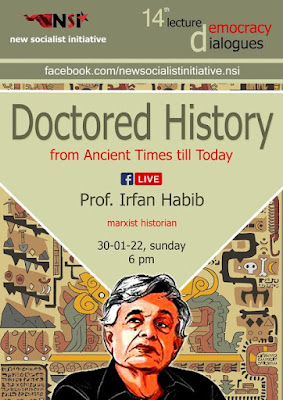
(Democracy Dialogue lecture Video) Doctored History : From Ancient Times till Today - Prof Irfan Habib


The 14th lecture in the Democracy Dialogues series organized by the New Socialist Initiative was delivered by Prof Irfan Habib on 30th January 2022 where he  spoke on "Doctored History : From Ancient Times till Today"


The 14th Lecture in the Democracy Dialogues Series  was delivered by Prof Irfan Habib, Marxist Historian and Public Intellectual, on Sunday  30th January 2022. Prof Habib would be speaking on 'Doctored History : From Ancient Times till Today'

 About the Speaker :

 Prof Irfan Habib ( Professor of History at the Aligarh Muslim University, Retd) is a well-known historian and author of the The Agrarian System of Mughal India ( 1963), An Atlas of the Mughal Empire ( 1982), Essays in Indian History : Towards a Marxist Perception ( 1985) , The Economic History of Medieval India : A Survey ( 2001) ,  Medieval India : The Study of a Civilization ( 2008), a multivolume study titled 'People's History of India' etc. and has edited many books.


About the Democracy Dialogues Series :

The idea behind this series - which we would like to call 'Democracy Dialogues' - is basically to initiate as well as join in the on-going conversation around this theme in academic as well as activist circles.

We feel that the very idea of democracy which has taken deep roots across the world, has come under scanner for various reasons. At the same time we have been witness to the ascendance of right-wing forces and fascistic demagogues via the same democratic route. There is this apparently anomalous situation in which the spread and deepening of democracy have often led to generating mass support for these reactionary and fascistic forces.

Coming to India, there have been valid concerns about the rise of authoritarian streak among Indians and how it has helped strengthen BJP's hard right turn. The strong support for democracy here is accompanied by increasing fascination towards majoritarian-authoritarian politics. In fact, we would like to state that a vigorous electoral democracy here has become a vehicle for hindutva-ite counterrevolution.


All videos  of  the Democracy Dialogues  series  lectures are available on  New Socialist Initiative YouTube channel